← All stories
Psychology

Thinking About Why Instead of How Dramatically Improves Self-Control Success
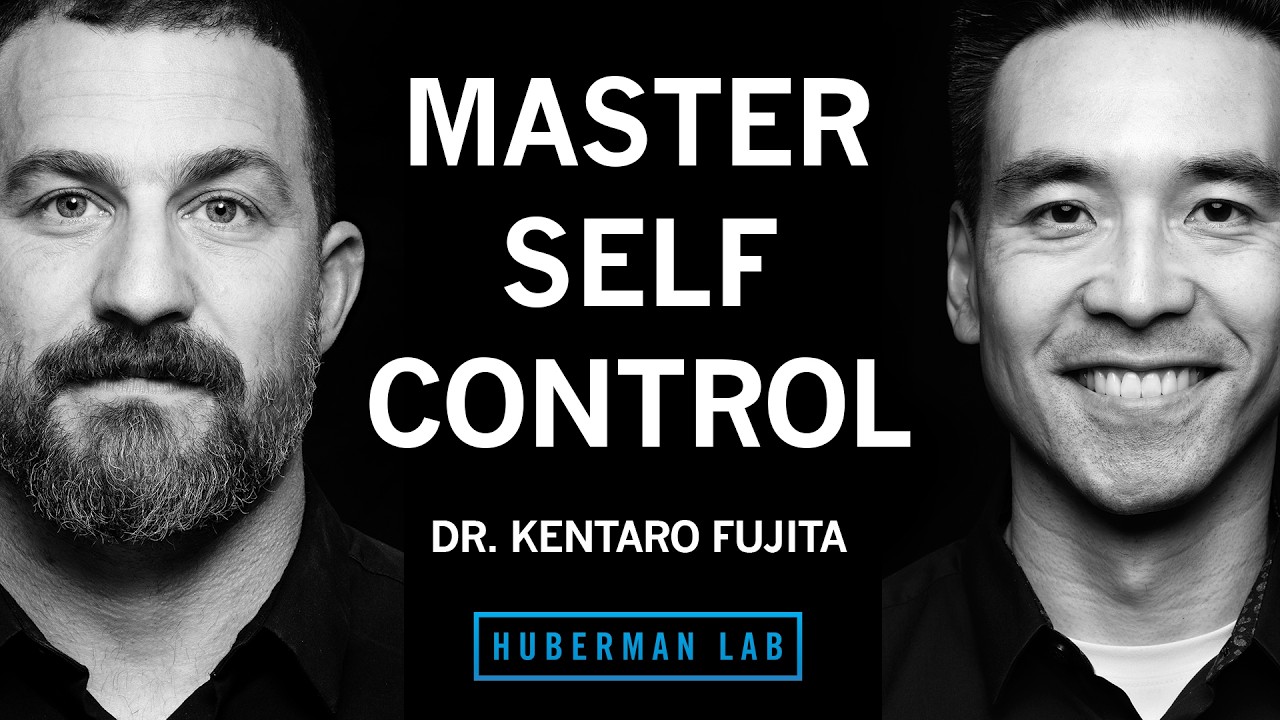
Huberman Lab · Master Self Control & Overcome Procrastination | Dr. Kentaro Fujita · May 11, 2026
Thinking About Why Instead of How Dramatically Improves Self-Control Success
Huberman Lab
Huberman Lab
Master Self Control & Overcome Procrastination | Dr. Kentaro Fujita
"In my own research, we have shown that if we can get people to think about their whys, the purposes behind their decisions, the broader purposes behind what they're doing, they're much more likely to be able to overcome the temptation."
Fujita's lab discovered that framing decisions around higher-order motivations—like family, values, and long-term identity—significantly increases self-control compared to focusing on immediate logistics. When facing temptation, connecting the moment to deeper meaning (wanting to be healthy for one's children) proves more effective than willpower alone or superficial reasons like "being on a diet."

About this episode

On this episode of the Huberman Lab Podcast, host Andrew Huberman was joined by Dr. Kentaro Fujita, professor of psychology at Ohio State University and expert in self-control, motivation, and goal pursuit. The conversation centered on practical, science-backed strategies for building self-control and achieving long-term goals, beginning with an exploration of the famous marshmallow test. Fujita revealed that while the test's predictive validity has been contested, its most important—and overlooked—finding was that self-control strategies can be taught and learned, making it a skill rather than an innate trait. The discussion dismantled several popular myths, including the concept of willpower depletion, which Fujita explained has failed to replicate in multiple large-scale studies despite being widely accepted for decades. A central theme emerged around the power of "why" over "how"—Fujita's research demonstrates that connecting immediate choices to higher-order purposes (family, identity, values) dramatically improves self-control compared to willpower alone or superficial reasoning. The episode also covered the self-control "toolbox" approach, emphasizing that different strategies work for different people and contexts, from psychological distancing techniques to third-person self-talk to visualization. Fujita challenged the optimization culture, arguing that doing hard things under non-ideal conditions may build more robust self-control than waiting for perfect circumstances. The conversation explored intrinsic versus extrinsic motivation, cultural differences in goal pursuit between Japanese and American approaches, and the often-ignored reality that humans simultaneously pursue multiple goals rather than single objectives. Fujita stressed that sustainable motivation requires intrinsic interest in the process itself, not just external rewards, and that self-control failures often represent learning opportunities for discovering better strategies rather than personal inadequacy.

Key takeaways

More stories More from Huberman Lab