Quinn Thompson says Kevin Warsh aims to tighten via long-end yields
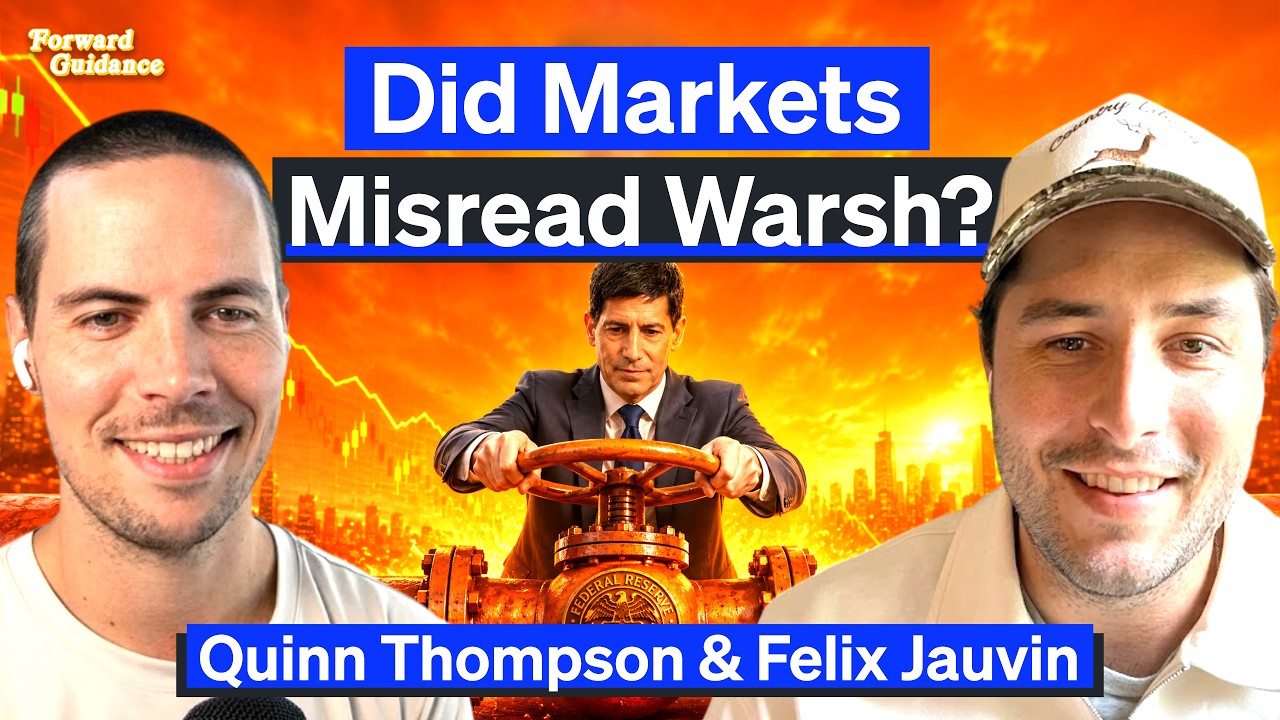
"The reason the long end increased was because he said that he wanted to remove balance sheet accommodation for the long end. He said at the outset he said a core question I posed to the committee and our task forces is how much accommodation is the long end uh is the Fed's balance sheet providing the the market and monetary policy."
About this episode
Forward Guidance hosts Felix Jauvin and Quinn Thompson focus on two linked themes: an apparent unwind in crowded AI-linked equity trades and an unusually volatile market reaction to a Federal Reserve meeting and press conference. Jauvin claims that “Leopold Ashbrer”, described as a high-profile AI-focused investor, sought to raise capital and then liquidated his firm’s public-market exposure, adding (without citing documentation) that private holdings such as Anthropic may also have been sold and that a single buyer took the risk.
The hosts argue the drawdown reflected leverage and positioning more than a clean reassessment of AI fundamentals, citing the impact of leveraged retail ETFs, reported Korean margin activity, and how a first notable earnings miss in the memory complex (they mention SK Hynix) may have coincided with a fragile tape. They then turn to the Fed: Jauvin references reporting and commentary that investors questioned the central bank’s credibility after a pause, while Thompson argues the press conference was misread and that Kevin Warsh was signalling a desire to tighten financial conditions by reducing balance-sheet support and allowing the long end to reprice.
In their outlook, they expect slower growth momentum as restrictive real yields and wider spreads filter through, but stop short of calling a recession given deficit-financed fiscal support. Thompson also suggests—speculatively—that political incentives ahead of midterms could lead officials to manage market conditions through messaging and volatility.
Key takeaways
- Felix Jauvin claims an AI-focused investor, “Leopold Ashbrer”, was forced to liquidate a large portfolio, potentially including private holdings such as Anthropic.
- The hosts attribute recent AI/semiconductor volatility partly to leverage and crowded positioning, including leveraged ETFs and margin dynamics.
- Quinn Thompson argues Fed chair Kevin Warsh is aiming to tighten via balance-sheet policy and higher long-end yields rather than solely front-end rate hikes.
- They interpret the post-meeting jump in long-end real yields and widening credit spreads as consistent with that balance-sheet-driven tightening thesis.
- Both hosts expect a cooling in growth momentum as tighter financial conditions feed through, while noting fiscal deficits can delay a recessionary outcome.
- Thompson alleges political considerations ahead of midterms could shape rate-hike timing and even encourage engineered market volatility.