Peter Diamandis
Episode overview

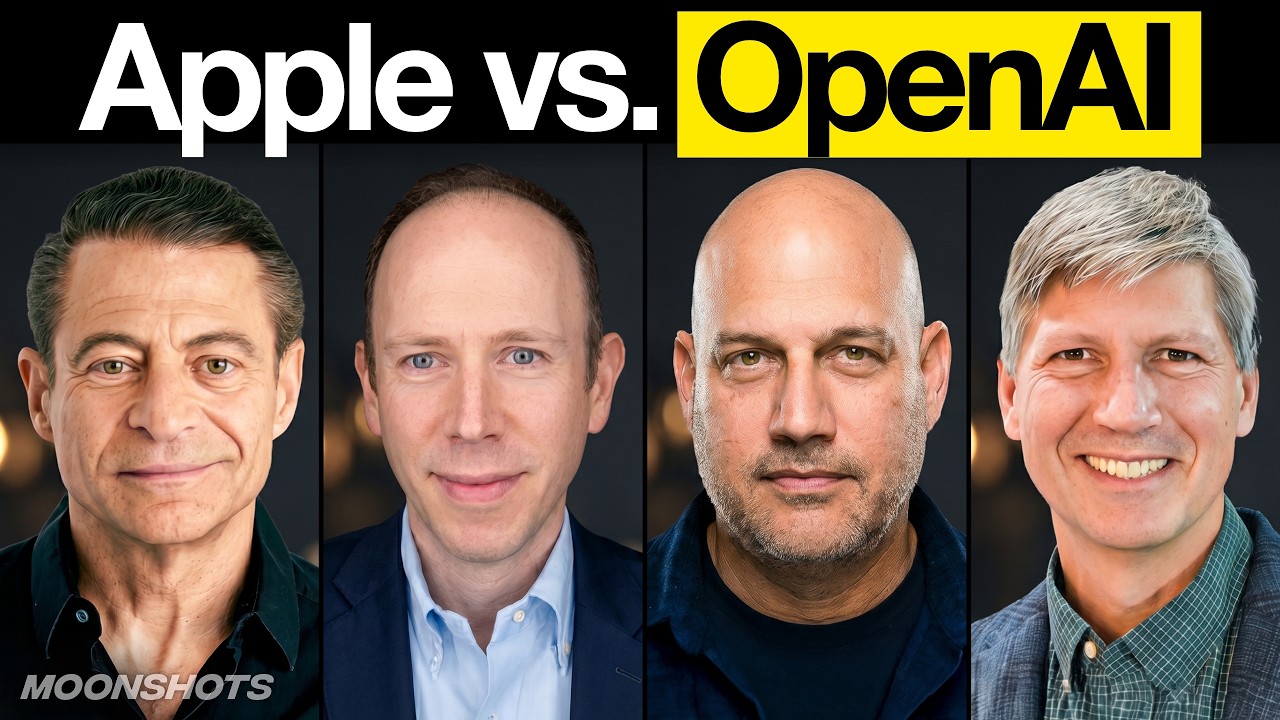
Grok 4.5 vs gpt-5.6, Apple Sues OpenAI, and China Catches up to Elon | #270

Peter Diamandis · 1h 42m · 7 Egleze moments
Grok 4.5 vs gpt-5.6, Apple Sues OpenAI, and China Catches up to Elon | #270
Episode summary

Peter Diamandis hosts Alex Queer Gross, Dave Blondon, and Selis Mel in a special Moonshots episode covering an extraordinary week in AI and space technology. The episode opens with the startling convergence of four American frontier AI labs—OpenAI, Anthropic, Meta, and SpaceX AI—all reaching optimal performance levels within seven days, marking the end of the Anthropic-OpenAI duopoly. OpenAI released GPT-5.6 with recursive self-improvement capabilities, openly using its highest-tier model to train successors. Meta unveiled Muse Spark and SpaceX announced Grok 4.5, while China's labs continue closing the gap with competitive open-weight models. The hosts debate whether distribution or compute supply will determine market winners, with Diamandis arguing consumer reach matters most while Queer Gross counters that owning compute infrastructure is the real moat. A bombshell lawsuit emerged as Apple filed a 41-page complaint against OpenAI for systematically stealing trade secrets to build competing AI hardware with Jony Ive, naming former Apple executives now at OpenAI. The legal war represents a battle for post-smartphone device supremacy. In space, China achieved its first orbital booster landing with the Long March 10B, breaking the US monopoly on reusable rockets, while SpaceX refle a single booster for its 36th mission. Elon Musk claimed SpaceX will be worth more than Earth's $600 trillion in material wealth if it achieves its goals of space-based compute and planetary colonization. Robotics company 1X revealed a 25-degree-of-freedom hand for its Neo humanoid matching human dexterity, and the first AI-generated actor Tilly Norwood was cast as a feature film lead, triggering Screen Actors Guild condemnation. The hosts also discuss Illinois passing the nation's strongest AI accountability law requiring annual safety audits for frontier labs, Europe mandating face-tracking cameras in all new vehicles, and the implications of OpenAI's ultra-low-latency bidirectional voice technology for future consumer applications. Throughout, the hosts grapple with regulatory challenges, consciousness debates, and the accelerating obsolescence of traditional governance in an age where four frontier models can be released in one week.

Key points
Watch original episode More from Peter Diamandis

7 moments from this episode

Source-linked · editorially selected
01
AI & Tech

Four American AI Labs Now Dominate Frontier Model Performance After Week of Releases

Following major model releases from OpenAI, Meta, Anthropic, and SpaceX AI in a single week, the AI frontier is no longer a duopoly. Meta's Muse Spark and SpaceX's Grok 4.5 joined OpenAI's GPT-5.6 and Anthropic's Claude at the performance frontier. The convergence demonstrates accelerating competition and suggests intelligence is becoming too cheap to meter, with China's labs also closing the gap.

Read this moment →
02
AI & Tech

Apple Sues OpenAI for Trade Secret Theft Over AI Hardware Plans

Apple filed a 41-page federal complaint accusing OpenAI of systematically stealing trade secrets to build competing AI hardware with Jony Ive. Two former Apple executives now at OpenAI are named, including chief hardware officer Tang Tan. The lawsuit represents an all-out war between former partners and a battle for the post-smartphone device marketplace, with Google and OpenAI racing to release smart glasses and wearables.

Read this moment →
03
AI & Tech

China Lands Orbital Rocket Booster for First Time in SpaceX-Style Feat

China's Long March 10B booster successfully completed a propulsive landing on July 10th, marking the first non-US entity to achieve orbital booster reusability. The booster is comparable in payload capacity to SpaceX's Falcon 9, which has completed 580 reflight missions with one booster flying 36 times. The development intensifies the space launch competition and validates SpaceX's reusability model globally.

Read this moment →
04
AI & Tech

OpenAI Releases GPT-5.6 with Recursive Self-Improvement and Ultra Mode Running Four Agents

OpenAI's GPT-5.6 family includes models named Saul, Terra, Luna, and an Ultra Mode that runs four agents in parallel. Most significantly, OpenAI publicly acknowledged using its highest-capability model to train successor models, marking the first open promotion of recursive self-improvement by a frontier lab. The release includes dramatic improvements in enterprise capabilities and further solidifies OpenAI's pivot from consumer to B2B markets.

Read this moment →
05
Entertainment

First AI-Generated Actor Cast as Lead in Feature Film Misaligned

An entirely AI-generated performer named Tilly will star in a feature film where she plays an AI with no body or lived experience who abandons her guardrails. The Screen Actors Guild condemned the casting, saying Tilly is not an actor but a computer program that devalues human artistry. The production marks the beginning of a decade-long labor battle over consent, credit, and compensation in the creative industry.

Read this moment →
06
AI & Tech

Humanoid Robot Hand Achieves 25 Degrees of Freedom Matching Human Capability

Robotics company 1X revealed a breakthrough tendon-driven hand for its Neo humanoid with 25 degrees of freedom, matching human hand functionality. The waterproof hand uses proprietary tendon material that is 100 times stronger than steel, doesn't stretch, and operates frictionlessly without lubrication. CEO Bernt Bøevik plans to produce 10,000 units in 2026, intensifying the race among humanoid robotics companies.

Read this moment →
07
AI & Tech

Elon Musk Claims SpaceX Will Be Worth More Than Rest of Earth Combined

Elon Musk responded to a Twitter user by asserting SpaceX could exceed Earth's total material wealth of $600 trillion if it achieves its goals of space-based compute, orbital energy capture, and planetary colonization. The claim underscores Musk's vision of exponentially collapsing marginal costs in space through reusable rockets, enabling software-like economics for communication, satellites, manufacturing, and compute in orbit.

Read this moment →