Lewis Howes School of Greatness
Episode overview

Evolution Designed Your Senses to Hide Reality | Donald Hoffman

Lewis Howes School of Greatness · 15 June 2026 · 5 Egleze moments
Evolution Designed Your Senses to Hide Reality | Donald Hoffman ▶

What happened in this episode?

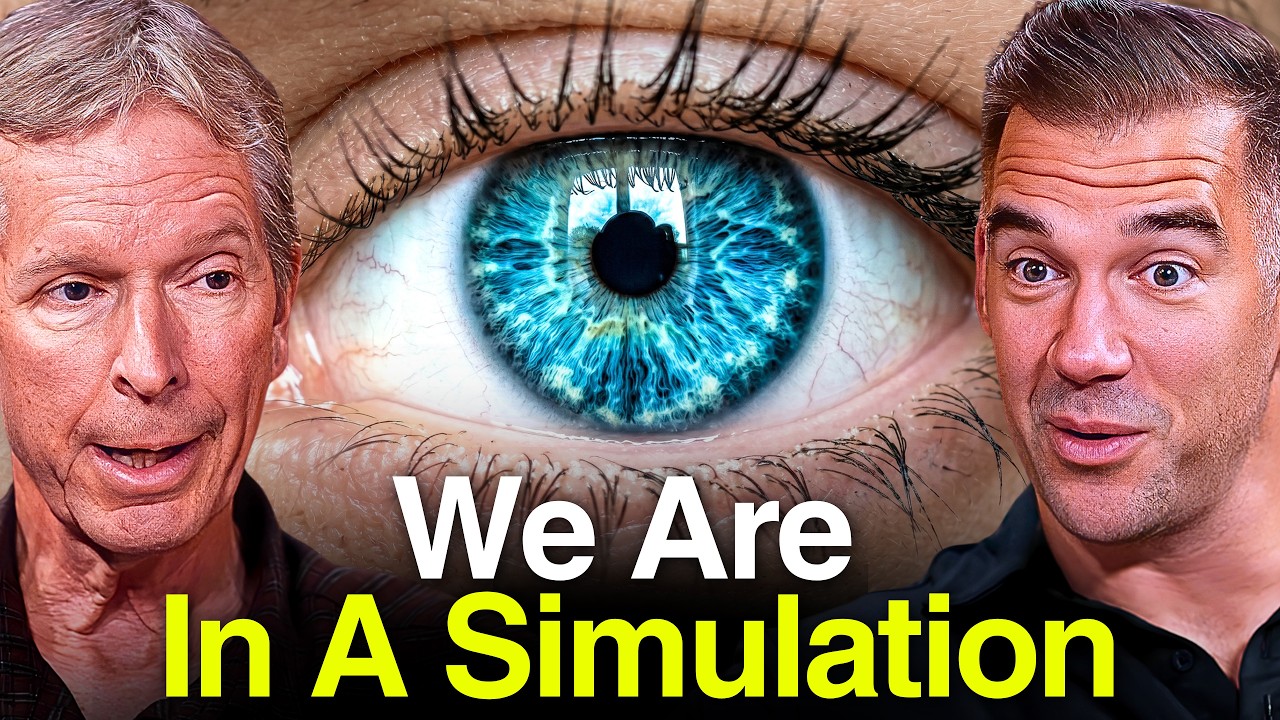
In this paradigm-challenging episode, host Lewis Howes interviews cognitive scientist and UC Irvine professor Donald Hoffman about the nature of reality, consciousness, and perception. Hoffman, who has spent over 40 years studying how humans perceive reality, presents a radical thesis: evolutionary mathematics proves with absolute certainty that humans never evolved to see reality as it is, but rather to navigate a survival game through what he calls a 'VR headset' interface. Drawing on high-energy theoretical physics research from the past decade, Hoffman explains how physicists have discovered mathematical structures called positive geometries existing outside spacetime, funded by a €10 million European Research Council initiative. He dismantles the physicalist assumption that brains create consciousness, arguing instead that consciousness creates the brain and that physical objects—including neurons—only exist when perceived. Hoffman proposes that one universal consciousness experiences reality through infinite avatars across countless dimensional headsets, with our three-dimensional spacetime being among the most trivial. The conversation becomes deeply practical as Hoffman shares meditation techniques for stepping back from emotional identification, drawing parallels between adult frustrations and a child losing a toy in a sandbox. He reveals his personal practice of spending tens of thousands of hours in silence to cultivate the 'watcher' perspective. Hoffman's forthcoming Trace Institute, launching June 3rd, aims to develop mathematical models showing how spacetime emerges from consciousness—research he believes will enable technologies that make current innovations look like firecrackers. Throughout, he addresses scientific pushback, clarifies why neuroscience remains important despite brains lacking causal power, and explains how DMT might alter dimensional parameters in our perceptual headset. The episode closes with Hoffman's three truths: love is central, you were the author all along, and infinite headsets await.

What are the key points?

Which topics are covered?

How is this page sourced?

Programme
Lewis Howes School of Greatness
Published
15 June 2026
Original episode
Open the original source ↗

Egleze verifies the speaker, source and timestamp for each linked moment. Unless a moment is explicitly marked independently verified, statements remain attributed claims by the named speaker rather than established facts.

Watch original episode More from Lewis Howes School of Greatness

5 moments from this episode

Source-linked · editorially selected
01
Science

Cognitive Scientist Claims Probability of Seeing Reality as It Is Zero

at 3:31 · Attributed speaker claim
If you look at the mathematics of evolutionary theory very, very carefully, it basically says the probability that any organism has ever been shaped to see any aspect of reality as it is is zero. In other words, the probability that we see the truth is zero.

Donald Hoffman, cognitive scientist and professor, argues that evolutionary theory mathematically proves humans never evolved to see reality as it truly is. Using evolutionary game theory, he claims natural selection shaped our senses not to reveal truth but to function like a VR headset optimized for survival. This directly contradicts the mainstream scientific assumption that perception approximates objective reality.

02
Science

Theoretical Physicists Finding Mathematical Structures Outside Spacetime Since 2013

at 12:22 · Attributed speaker claim
The European Research Council, the ERC, has a €10 million initiative right now, and there are many, many high-energy theoretical physicists and mathematicians that are finding what are called positive geometries outside of spacetime. So there are new mathematical structures that code for properties of particle interactions inside spacetime beautifully.

Hoffman reveals that since 2013, high-energy theoretical physicists have been discovering positive geometries—mathematical structures existing outside spacetime—that predict particle interactions with precision. This represents a paradigm shift in physics, as researchers now work entirely outside quantum theory and spacetime frameworks, funded by a €10 million European Research Council initiative.

03
Consciousness & Medicine

Researcher Proposes Reality Functions Like VR Game Rendered by Consciousness

at 13:28 · Attributed speaker claim
What we evolved was more like a headset, a VR headset to play the game of life. You're not seeing the reality, which in this example would be there's some supercomputer somewhere with all sorts of bits running. That's the reality. All I can see is this headset. The person who doesn't see that reality of the computer and just sees a little fake steering wheel and the fake cars is going to beat you.

Hoffman presents a controversial theory that human perception works like a virtual reality headset, with evolution optimizing us to play a survival game rather than perceive objective truth. He argues that spacetime and physical objects only exist when perceived—similar to objects rendering in video games—and that one consciousness experiences reality through infinite avatars.

04
Science

Neuroscientist Claims Brains Create Zero Conscious Experiences Despite Decades of Research

at 38:37 · Attributed speaker claim
There are all these theories of consciousness and not a one of them can explain a single conscious experience. We've been at this for decades. And the reason you can't do it is not because they're not smart. They're brilliant. And you just can't do that. You can't start with non-conscious ingredients and boot up consciousness.

Despite decades of neuroscience research by brilliant scientists, Hoffman asserts that no existing theory—including integrated information theory or quantum microtubule theories—can explain even one conscious experience like the taste of mint. He argues this failure proves consciousness cannot emerge from physical brain processes, challenging the physicalist foundation of mainstream neuroscience.

05
AI & Tech

Professor Predicts Understanding Consciousness Will Enable Technologies That Look Like Magic

at 48:45 · Attributed speaker claim
Understanding consciousness as a scientific theory will give us technologies that will make our current technologies look like firecrackers. If you're the geek who can't even drive a car very well, but you wrote the code, you can do magic. You can take the car of the wizard and turn it into a donkey if you want to. You can do anything.

Hoffman forecasts that once scientists reverse-engineer how consciousness generates spacetime, humanity will develop technologies indistinguishable from magic by manipulating the code underlying reality. He compares this to a video game programmer who can alter game rules at will, suggesting mastery of consciousness could transcend current physics limitations entirely.