← All stories
Consciousness & Medicine

Researcher Proposes Reality Functions Like VR Game Rendered by Consciousness
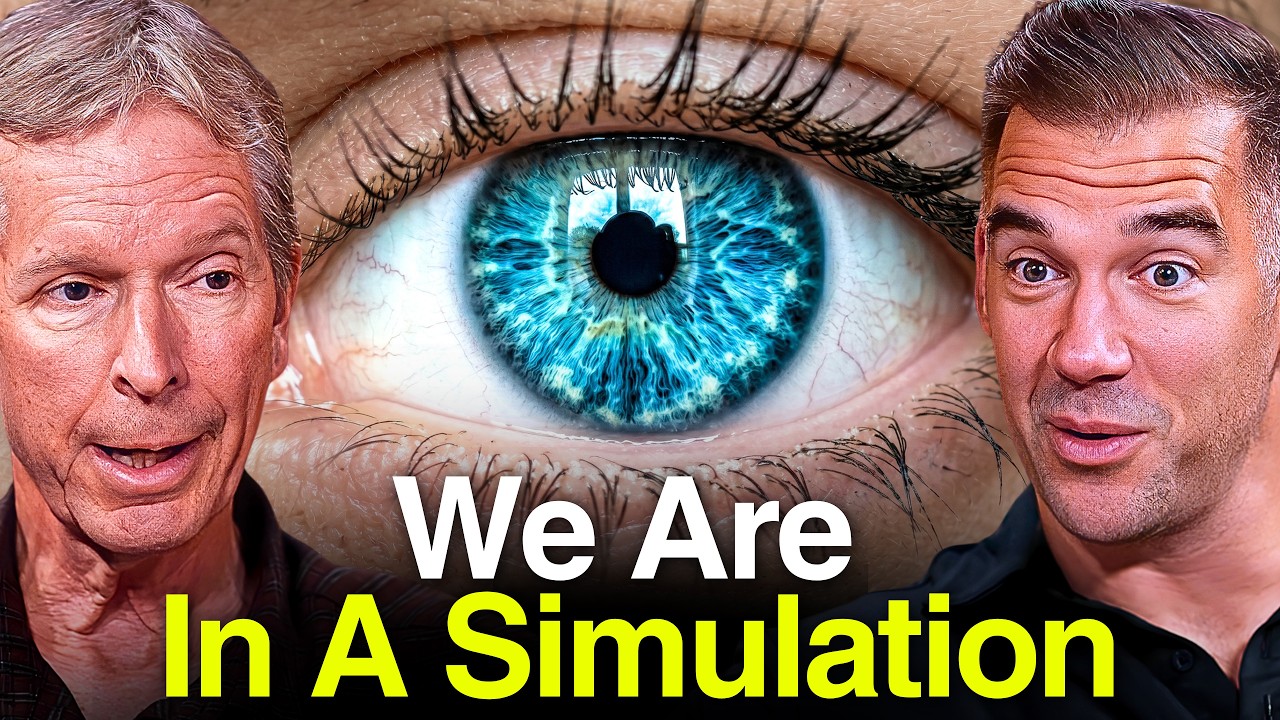
Lewis Howes School of Greatness · Evolution Designed Your Senses to Hide Reality | Donald Hoffman · June 15, 2026
Researcher Proposes Reality Functions Like VR Game Rendered by Consciousness
Lewis Howes School of Greatness
Evolution Designed Your Senses to Hide Reality | Donald Hoffman
"What we evolved was more like a headset, a VR headset to play the game of life. You're not seeing the reality, which in this example would be there's some supercomputer somewhere with all sorts of bits running. That's the reality. All I can see is this headset. The person who doesn't see that reality of the computer and just sees a little fake steering wheel and the fake cars is going to beat you."
Hoffman presents a controversial theory that human perception works like a virtual reality headset, with evolution optimizing us to play a survival game rather than perceive objective truth. He argues that spacetime and physical objects only exist when perceived—similar to objects rendering in video games—and that one consciousness experiences reality through infinite avatars.

About this episode

In this paradigm-challenging episode, host Lewis Howes interviews cognitive scientist and UC Irvine professor Donald Hoffman about the nature of reality, consciousness, and perception. Hoffman, who has spent over 40 years studying how humans perceive reality, presents a radical thesis: evolutionary mathematics proves with absolute certainty that humans never evolved to see reality as it is, but rather to navigate a survival game through what he calls a 'VR headset' interface. Drawing on high-energy theoretical physics research from the past decade, Hoffman explains how physicists have discovered mathematical structures called positive geometries existing outside spacetime, funded by a €10 million European Research Council initiative. He dismantles the physicalist assumption that brains create consciousness, arguing instead that consciousness creates the brain and that physical objects—including neurons—only exist when perceived. Hoffman proposes that one universal consciousness experiences reality through infinite avatars across countless dimensional headsets, with our three-dimensional spacetime being among the most trivial. The conversation becomes deeply practical as Hoffman shares meditation techniques for stepping back from emotional identification, drawing parallels between adult frustrations and a child losing a toy in a sandbox. He reveals his personal practice of spending tens of thousands of hours in silence to cultivate the 'watcher' perspective. Hoffman's forthcoming Trace Institute, launching June 3rd, aims to develop mathematical models showing how spacetime emerges from consciousness—research he believes will enable technologies that make current innovations look like firecrackers. Throughout, he addresses scientific pushback, clarifies why neuroscience remains important despite brains lacking causal power, and explains how DMT might alter dimensional parameters in our perceptual headset. The episode closes with Hoffman's three truths: love is central, you were the author all along, and infinite headsets await.

Key takeaways

More stories More from Lewis Howes School of Greatness