Found My Fitness
Episode overview

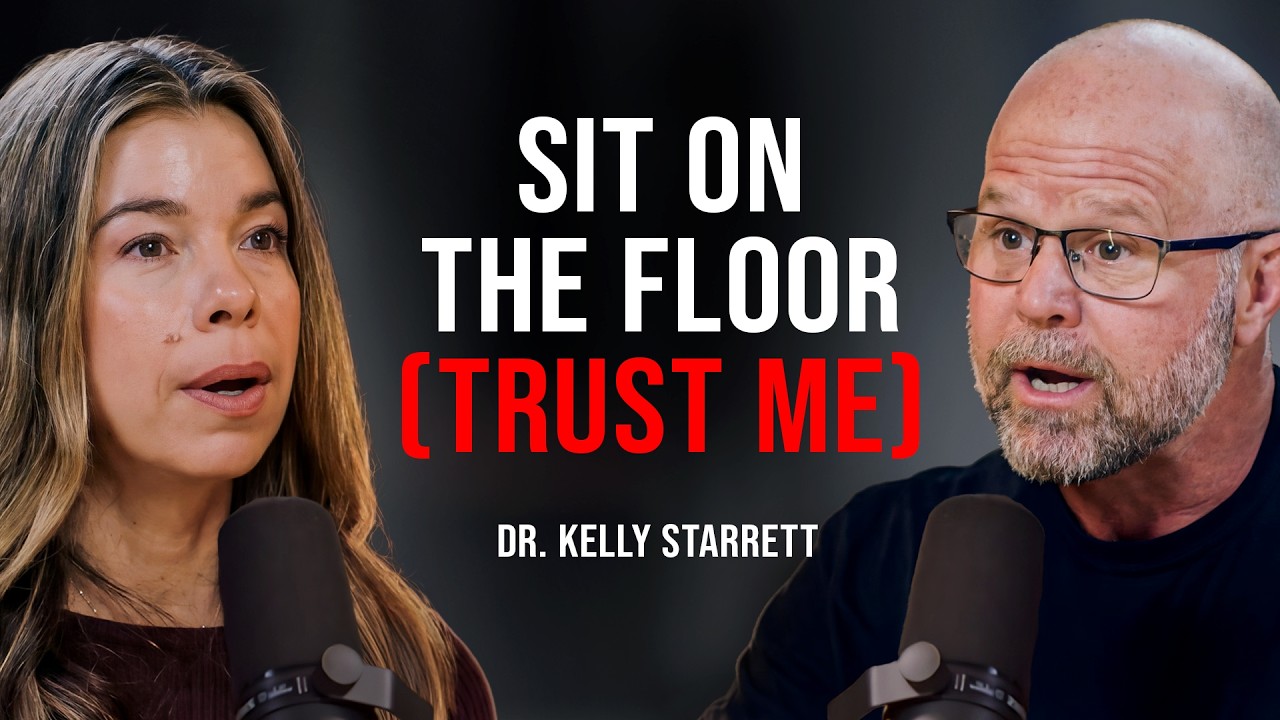
#111 The Optimal Mobility Protocol for a Durable Body | Dr. Kelly Starrett

Found My Fitness · 4 May 2026 · 5 Egleze moments
#111 The Optimal Mobility Protocol for a Durable Body | Dr. Kelly Starrett ▶

What happened in this episode?

In this comprehensive episode, Dr. Rhonda Patrick sits down with Dr. Kelly Starrett, a renowned physical therapist, movement expert, and co-founder of The Ready State, for a wide-ranging conversation about mobility, pain, recovery, and youth athletic development. Starrett challenges conventional approaches to pain management, arguing that pain is often a request for change rather than evidence of injury, and that most nagging discomfort stems from missing range of motion, poor tissue perfusion, or positional inhibition rather than structural damage. He provides practical frameworks for assessing shoulder and hip mobility at home, explains why breathwork and trunk mechanics underpin nearly all movement quality, and details how simple interventions like hanging, floor sitting, and movement snacks throughout the day can dramatically improve durability and reduce injury risk. The conversation reveals shocking insights about youth sports, including that orthopedic surgeons now hand-drill ACL repairs because children's bones have become so soft, that the average American spends only 20 minutes outdoors per week, and that sleep remains the single most powerful injury prevention tool for young athletes. Starrett and Patrick discuss the dangers of early sport specialization, the disappearance of free play, and how parents have become unwitting high-performance directors navigating nutrition, recovery, and psychological pressures without adequate training. Starrett emphasizes his mantra 'train for life, don't live to train,' advocating for movement practices that support long-term durability, playability, and community connection over obsessive performance optimization. The episode also covers desk ergonomics, the role of sauna and cold exposure in recovery, foam rolling science, the importance of leisure-time physical activity, and why movement choice and range of motion—not just strength or cardiovascular capacity—are the keys to aging well.

What are the key points?

Which topics are covered?

How is this page sourced?

Programme
Found My Fitness
Published
4 May 2026
Original episode
Open the original source ↗

Egleze verifies the speaker, source and timestamp for each linked moment. Unless a moment is explicitly marked independently verified, statements remain attributed claims by the named speaker rather than established facts.

Watch original episode More from Found My Fitness

5 moments from this episode

Source-linked · editorially selected
01
Health, Longevity & Biohacking

Starrett Claims Shoulder Pain Often Stems From Missing Rotational Range Not Injury

at 1:29:20 · Attributed speaker claim
The shoulder really does 4 things. Arm goes over your head, arm goes out in front, arm goes out to the side, arm goes behind. I should have a rotational window of about 160 degrees. If my hand is here, I should be able to get my hand all the way down to my hip if I was laying on the ground without my shoulder coming forward. And that shoulder coming forward is how your body solves the problem if you can't access that position. That's potentially the mechanism of injury for biceps tears, for labral tears.

Dr. Kelly Starrett explained that many shoulder injuries, including biceps and labral tears, result from compensating for missing rotational range of motion rather than from acute trauma. He emphasized that most people lack the normal 160-degree rotational window in the shoulder, forcing the body to compensate in ways that create injury risk over time.

02
Health, Longevity & Biohacking

Physical Therapist Reveals Frozen Shoulder Called 50 Year Old Shoulder in Japan

at 1:33:03 · Attributed speaker claim
Frozen shoulder translates in Japanese and Chinese to 50-year-old shoulder. Isn't that weird? Yes, that's what it's called, 50-year-old shoulder. We are more aware that this should be a component of care for women who are perimenopausal and menopausal when we're suddenly seeing occult frozen shoulder.

Starrett revealed that frozen shoulder, predominantly affecting perimenopausal and menopausal women, is literally called '50-year-old shoulder' in Japanese and Chinese. He argued that the medical community has failed women by not recognizing the musculoskeletal syndrome of menopause as a root cause requiring hormonal intervention alongside physical therapy.

03
Health, Longevity & Biohacking

Average American Spends Only 20 Minutes Outside Per Week Says Movement Expert

at 2:15:40 · Attributed speaker claim
The average American is spending 20 minutes outside a week. Get out. That's what the data says. The average American is spending 20 minutes outside a week, and this is just in any environment, not necessarily nature.

Citing research from NatureQuant, Starrett revealed that the average American spends a shockingly low 20 minutes outdoors per week, not accounting for quality of outdoor environment. This sedentary, indoor lifestyle eliminates critical inputs for mental health, circadian rhythm, vitamin D production, and community connection.

04
Health, Longevity & Biohacking

Youth Bone Density Crisis Revealed Through ACL Surgery Technique Change

at 2:40:21 · Attributed speaker claim
There's a physician we work with who is president of the Knee Society for ACLs. And when a kid would tear his ACL or her ACL in the '80s and '90s, they pull out this big drill, drill into the cortical bone. It's very intense. The bones are hard. Now they just core the bone by hand. They just hand-turn the drill because the bones are so soft. So we're seeing this demineralization, this less hardening of the bones of children.

Starrett disclosed that orthopedic surgeons now perform ACL reconstruction on children using hand-turned drills instead of power tools because youth bones have become dramatically softer over recent decades. This shocking revelation points to a widespread demineralization crisis among young athletes linked to nutrition, movement patterns, and lifestyle factors.

05
Health, Longevity & Biohacking

Movement Coach Claims Sleep Trumps All Other Injury Prevention for Youth Athletes

at 2:47:00 · Attributed speaker claim
If you are interested in protecting your children so that they're less likely to be injured, sleep would be the number one thing I would lean into. There's not a single study that says that a child needs less than 8 to 10 hours of sleep. Zero studies say that. If you're growing a body, you need more than that.

Starrett asserted that sleep is the single most powerful injury prevention tool for young athletes, more effective than any training protocol or protective equipment. He emphasized that all research confirms children require 8-10 hours nightly, yet most youth athletes fall far short due to late practices, early school start times, and technology.