Julian Dorey Daily
Episode overview

PROOF Joe Kent's Predictions have Aged Like Fine Wine

Julian Dorey Daily · 25 July 2026 · 1h 0m · 4 Egleze moments
PROOF Joe Kent's Predictions have Aged Like Fine Wine ▶

What happened in this episode?

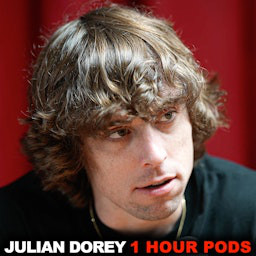
Julian Dorey interviews Joe Kent, introduced as a former senior counterterrorism official working under US Director of National Intelligence Tulsi Gabbard, about his decision to resign in March amid the Iran conflict. Kent frames the war as avoidable and morally unacceptable, citing his military background and the death of his late wife. He alleges that Israel’s government and a supporting ecosystem of donors, media and think-tanks exerted undue influence on US decision-making and helped shift President Donald Trump’s effective red line on Iran from preventing a nuclear weapon to demanding zero enrichment—an approach Kent says Iran would not accept.

Kent describes internal debates ahead of a “12-day war” and “Operation Midnight Hammer”, saying he and others floated proposals intended to deter an Israeli strike but were ignored. He claims Israeli officials privately prioritised regime change or “regime decapitation” in Tehran and were prepared for a rally-around-the-flag effect, while publicly selling the nuclear issue as the central threat. Kent also contends that Trump’s earlier efforts to withdraw forces from Syria and Afghanistan were obstructed by officials and bureaucratic inertia, and argues such dynamics can prevent the president from ensuring execution of decisions.

In a broader institutional critique, Kent says US intelligence collection capabilities in places like Iran have atrophied, increasing reliance on liaison reporting—including from Israel—making independent verification harder during crises.

Key points:

- Kent says he resigned on principle over the Iran war and wanted to speak publicly about how it was decided.

- He alleges Israel and allied networks influenced US red lines and messaging on Iran.

- He claims Trump’s Syria drawdown order was blocked, and connects that delay to his wife’s death.

- He says officials proposed steps to deter an Israeli strike before the “12-day war” but were rebuffed.

- He argues US unilateral intelligence collection on Iran has weakened, increasing reliance on Israeli liaison intelligence.

- Kent says Israeli officials privately spoke in terms of regime change/decapitation rather than only nuclear concerns.
What are the key points?

Which topics are covered?

How is this page sourced?

Programme
Julian Dorey Daily
Published
25 July 2026
Duration
1h 0m
Original episode
Open the original source ↗

Egleze verifies the speaker, source and timestamp for each linked moment. Unless a moment is explicitly marked independently verified, statements remain attributed claims by the named speaker rather than established facts.

Watch original episode More from Julian Dorey Daily

4 moments from this episode

Source-linked · editorially selected
01
Military

Kent claims Trump’s Syria withdrawal was blocked; links delay to wife’s death

at 16:02 · Attributed speaker claim
He was trying to get our guys out. He was blocked from getting our guys out of Syria. That's why my late wife was killed. She was >> He was blocked. >> Yes. He was blocked by pretty much the bureaucrats in his own administration.

Kent claims Donald Trump ordered US troops out of Syria after ISIS lost territory in 2018, but senior officials and “bureaucrats” stalled the decision. He says his late wife was killed because the withdrawal did not happen on the planned timeline, describing it as an example of how presidents can be thwarted by internal process and resistance.

02
Geopolitics

Kent argues Israel shifted Trump’s Iran red line to ‘no enrichment’

at 27:22 · Attributed speaker claim
President's red line was no nuclear weapon. The Iranians agreed. They were able to make the president's red line no nuclear enrichment. Knowing that that was a poison pill for the Iranians because anytime we say no enrichment to the Iranians, the Iranians say no, absolutely not.

Kent says Trump’s stated position on Iran originally focused on preventing a nuclear weapon, which he claims aligned with Iran’s own policy, including a prohibition he says had held since 2003. He argues Israeli officials and aligned US media and donor networks pushed Washington towards a “no enrichment” demand that Iran would reject, making conflict more likely.

03
Geopolitics

Kent says officials urged pre-emptive steps to deter Israeli strike

at 33:00 · Attributed speaker claim
Yeah, we proposed this in order to prevent the 12-Day War from happening, to prevent the Israelis from attacking, because we knew that once the Israelis got off the ground with this attack, law of unintended consequences, we don't know what's going to happen.

Kent says he and others floated and then proposed, at a senior level, an idea intended to prevent the “12-Day War” by deterring Israel from attacking. He says they lost that argument and “didn't take anything away from the Israelis,” after which Israel carried out the attacks and Trump conducted “Midnight Hammer.”

04
Espionage

Kent claims US Iran intelligence collection ‘atrophied’, increasing reliance on Israel

at 57:09 · Attributed speaker claim
our capabilities to collect intelligence in a lot of places, Iran being one of them, like it's they have significantly atrophied. Uh John Brennan, who I think most people know from being the CIA director. >> Yeah. Great guy. >> Yeah. Right.

Kent argues that US unilateral intelligence collection in places like Iran has “significantly atrophied”, which he links to organisational choices that prioritised analysts and risk aversion. He says the US has leaned heavily on liaison intelligence—particularly from Israel—leaving Washington less able to independently verify claims about Iranian activity.