Feel Better, Live More with Dr Rangan Chatterjee
Episode overview

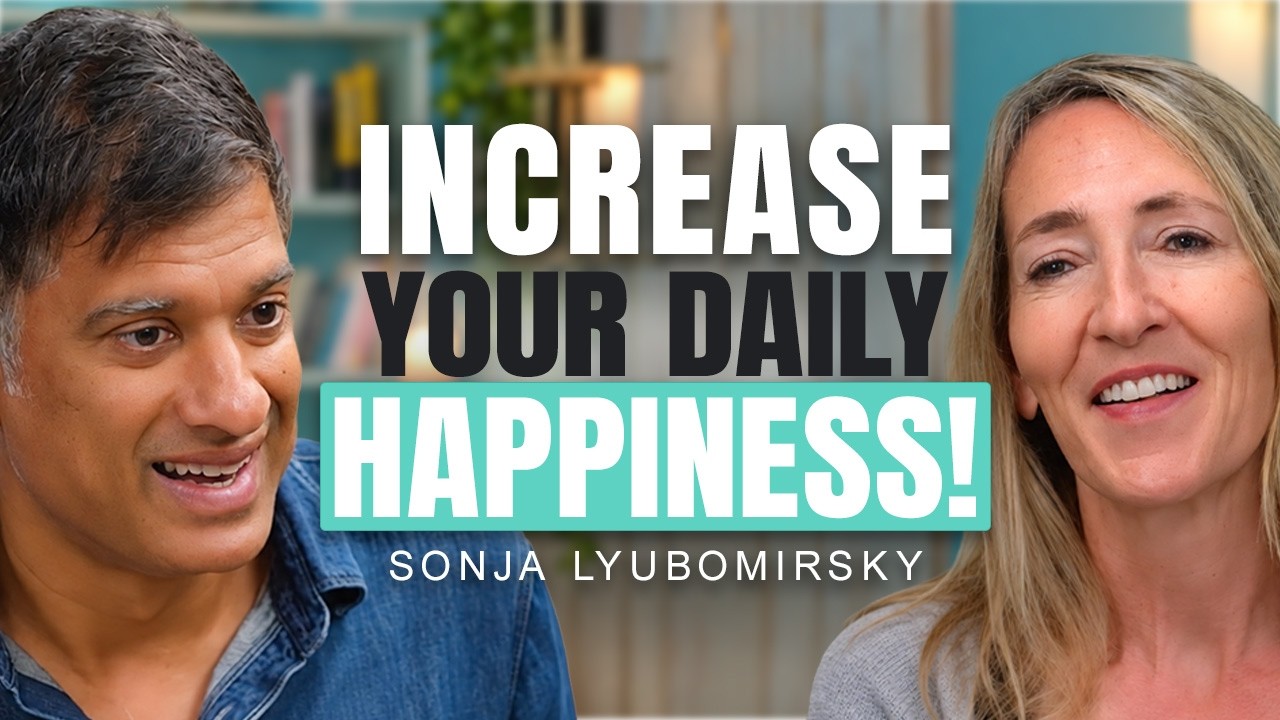
How To Find True Happiness (What 36 Years of Research Reveals) | Sonja Lyubomirsky

Feel Better, Live More with Dr Rangan Chatterjee · 30 September 2026 · 1h 59m · 3 Egleze moments
How To Find True Happiness (What 36 Years of Research Reveals) | Sonja Lyubomirsky ▶

What happened in this episode?

Dr Rangan Chatterjee speaks with psychologist Sonja Lyubomirsky about decades of happiness research and how it translates into everyday behaviour. Lyubomirsky challenges the “I’ll be happy when…” mindset, arguing that people quickly adapt to improved circumstances (hedonic adaptation), so external changes often fail to deliver lasting contentment. On money, she describes a nuanced picture: income matters most in alleviating poverty, and she cites findings suggesting additional money may increase happiness mainly among people who are already happier. She also argues that wellbeing can precede success, pointing to research linking positive mood with creativity, confidence and flexible thinking.

The pair discuss health associations, with Lyubomirsky citing experimental work in which participants were exposed to rhinovirus and happier people were less likely to develop colds and recovered faster, while noting much of the broader health literature is correlational. Cultural norms around expressing happiness and love are explored through Lyubomirsky’s childhood in Russia and later life in the US.

A central theme is her view that “feeling loved” is foundational to happiness. She and Chatterjee unpack five proposed “mindsets” for fostering that feeling—radical curiosity, sharing, listening to learn, open heart, and multiplicity (seeing people as complex rather than defined by one trait). She cites studies on gratitude practices, including a comparison of private gratitude, texting thanks, and social-media posting, and points to evidence that even small interactions—such as chatting with a barista—can lift mood.

What are the key points?

Who is speaking?

Named speakers identified in Egleze's source-linked moments from this episode.

Which topics are covered?

How is this page sourced?

Programme
Feel Better, Live More with Dr Rangan Chatterjee
Published
30 September 2026
Duration
1h 59m
Original episode
Open the original source ↗

Egleze verifies the speaker, source and timestamp for each linked moment. Unless a moment is explicitly marked independently verified, statements remain attributed claims by the named speaker rather than established facts.

Watch original episode More from Feel Better, Live More with Dr Rangan Chatterjee

3 moments from this episode

Source-linked · editorially selected
01
Psychology

Sonja Lyubomirsky says research suggests happiness can precede success

Sonja Lyubomirsky · at 5:28 · Attributed speaker claim
Happy people happiness is also good for us because it actually leads to success. So even though yes this go- getting this always wanting more can actually detract from happiness there's the opposite causal direction that happier people are actually more likely to succeed.

Sonja Lyubomirsky argues that the relationship between success and happiness is not one-way, saying there is an “opposite causal direction” in which happier people are more likely to succeed. She links this to factors such as creativity, flexible thinking, confidence and optimism, and says “hundreds of studies” support the broader idea that “when you feel better, you do better”.

02
Psychology

Sonja Lyubomirsky says gratitude texting increased connection more than private writing or social-media posting

Sonja Lyubomirsky · at 1:23:55 · Attributed speaker claim
We did another study where we had people either write to themselves gratitude or text it to another person or express it on social media because we thought that might be interesting comparison. We actually found that all of those conditions uh were associated with more happiness. But only one of those three people felt more connected.

Sonja Lyubomirsky says her team compared expressing gratitude by writing privately, texting another person, or posting on social media. She reports that all three approaches were associated with greater happiness, but that increased feelings of connection appeared only in the one-to-one texting condition.

03
Society

Sonja Lyubomirsky cites study finding brief barista chats linked to higher happiness than mobile ordering

Sonja Lyubomirsky · at 1:54:22 · Attributed speaker claim
There's actually a study on this. People were asked to buy coffee at Starbucks by either chatting a little bit with the barista and asking for the coffee or just sort of ordering it on their phone and just picking it up. And people were happier when they actually had to sort of say something to the barista.

Sonja Lyubomirsky cites a study in which people bought coffee either by chatting briefly with a barista or by ordering on a phone and collecting it. She says participants reported being happier when they interacted with the barista.