← All stories
Science

Tyson says black holes preserve information through particle pairs that remember
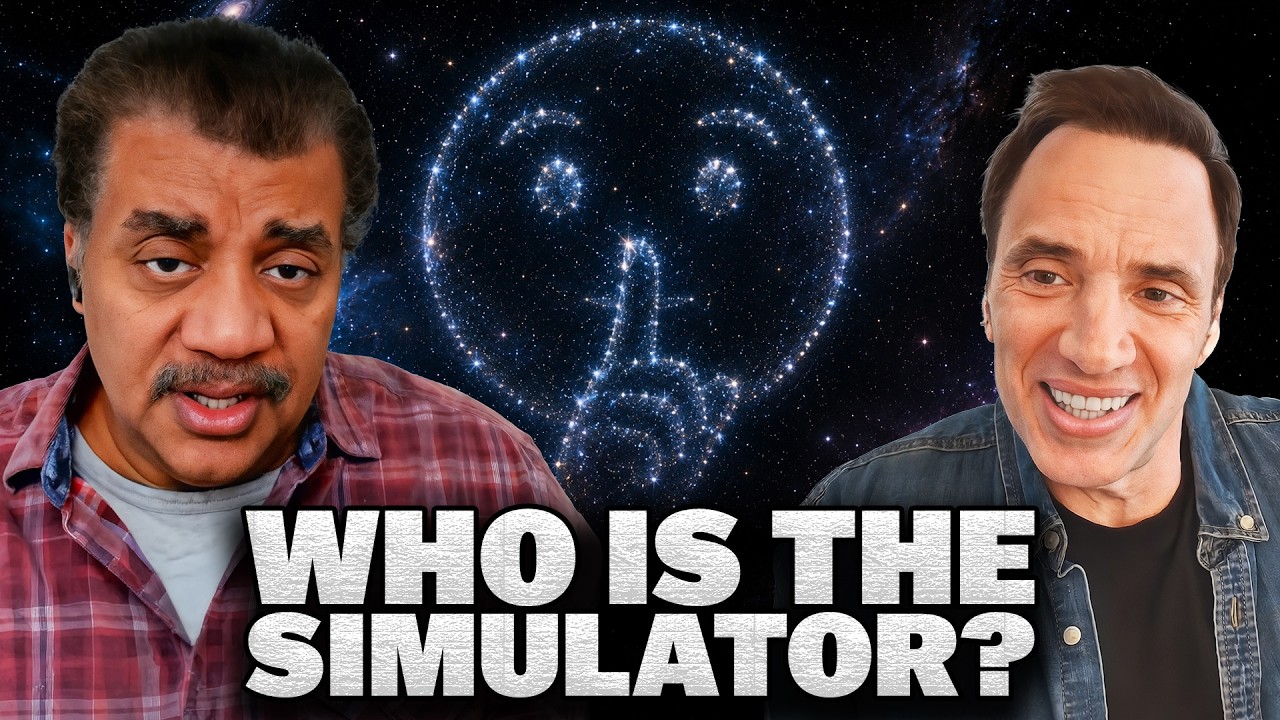
StarTalk Radio · Would You Really Want to Know if You’re in a Simulation? · July 14, 2026
Tyson says black holes preserve information through particle pairs that remember
StarTalk Radio
StarTalk Radio
Would You Really Want to Know if You’re in a Simulation?
"If you took an inventory of the particles that appear out of the gravitational field of the black hole, they will exactly match everything the black hole has ever eaten in its life. Particles are being created from the energy field of the black hole. Energy is creating it and it has a memory of what was there before."
Tyson described how Hawking radiation creates particle pairs from a black hole's gravitational field that somehow preserve the information of everything ever consumed by the black hole, even though the original particles are destroyed. This relates to the black hole information paradox in physics. However, Tyson admitted uncertainty about how complex information like DNA could be recovered from these particle pairs.

About this episode

Neil deGrasse Tyson and comedian Paul Mercurio tackle listener questions in this Cosmic Queries edition of StarTalk, ranging from relativity and black holes to consciousness and simulated reality. The most striking segment addresses the nature of consciousness, where Tyson argues that stroke patients experiencing gradual loss of cognitive functions represent multiple partial deaths of the brain, suggesting death is simply the complete cessation of electrochemical activity with no afterlife—a claim he acknowledges is not comforting to religious believers. On the simulation hypothesis, both Tyson and Mercurio say they would demand to speak with the programmers to understand whether the universe is fully knowable through physics or contains zones of randomness where science loses utility. Tyson reveals that GPS satellites must pre-correct their time signals for Einstein's relativity because they experience time faster than we do on Earth's surface, demonstrating how abstract physics enables everyday technology. Addressing the Interstellar film, Tyson explains that observers near a black hole would see the rest of the universe unfold rapidly while appearing in slow motion to distant observers due to time dilation. On black holes and information theory, he describes how Hawking radiation creates particles that somehow preserve information about everything a black hole consumed, though he admits uncertainty about recovering complex data like DNA. The episode also covers whether Earth would maintain orbit if the sun became a black hole, the cosmic web structure of galaxy distribution, and how dementia affects memory storage. Throughout, Mercurio injects personal anecdotes about his mother's dementia and his career dating back to the original Daily Show with Craig Kilborn.

Key takeaways

More stories More from StarTalk Radio