← All stories
Science

Computer Simulations Reveal All Galaxies Formed Through Violent Collisions
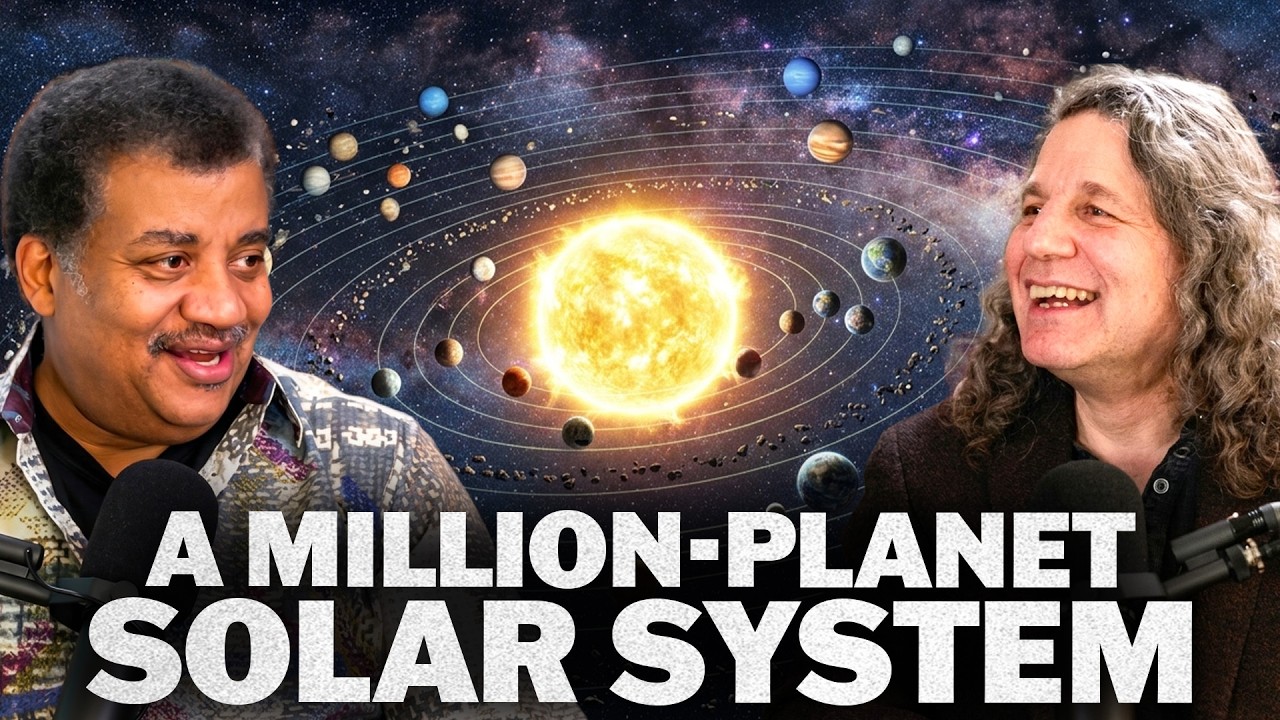
StarTalk Radio · The Universe is Stranger Than We Could’ve Imagined, with Mordecai-Mark Mac Low · July 7, 2026
Computer Simulations Reveal All Galaxies Formed Through Violent Collisions
StarTalk Radio
StarTalk Radio
The Universe is Stranger Than We Could’ve Imagined, with Mordecai-Mark Mac Low
"Every galaxy in the universe has collided with other galaxies. That's how galaxies are made. Bug splats turn into beautiful elliptical galaxies smooth uniform homogeneous because they get complete they're disc galaxies that get completely blenderized."
Astrophysicist Mordecai-Mark Mac Low explains that computer modeling has definitively shown all galaxies, including the Milky Way, formed through massive collisions. What appear as disturbed 'peculiar galaxies' in telescopes are simply galaxies caught mid-collision, eventually forming smooth elliptical galaxies after being completely 'blenderized.'

About this episode

Neil deGrasse Tyson hosts astrophysicist Mordecai-Mark Mac Low and comedian Negin Farsad for a Cosmic Queries episode examining planet and galaxy formation. Mac Low, the founding hire of the American Museum of Natural History's astrophysics department and a 37-year colleague of Tyson's, specializes in computer simulations that model cosmic processes impossible to calculate by hand. The conversation reveals several striking findings: every galaxy in the universe formed through violent collisions with other galaxies, with disturbed-looking 'peculiar galaxies' simply caught mid-crash before blenderizing into smooth elliptical forms. Mac Low discloses recently accepted research showing supermassive black holes can spawn million-planet systems containing Jupiter-mass rocky worlds, though the extreme radiation environment would be hostile to life. He reveals evidence that the Milky Way's central black hole had a major outburst just 5 million years ago, detected via shock waves spreading through the galaxy. The discussion covers how black holes become the brightest objects in the universe by heating infalling gas to billions of degrees, why magnetic fields and turbulence both promote and inhibit star formation, and how computer simulations must constantly be validated against observations to avoid being mere sandbox play. Mac Low explains that despite the universe's apparent chaos involving collisions, explosions, and turbulence, it remains comprehensible through just a few fundamental laws of physics, keeping astrophysicists employed rather than retired to the Bahamas.

Key takeaways

More stories More from StarTalk Radio