Simulations Show Million Planet Systems Form Around Supermassive Black Holes
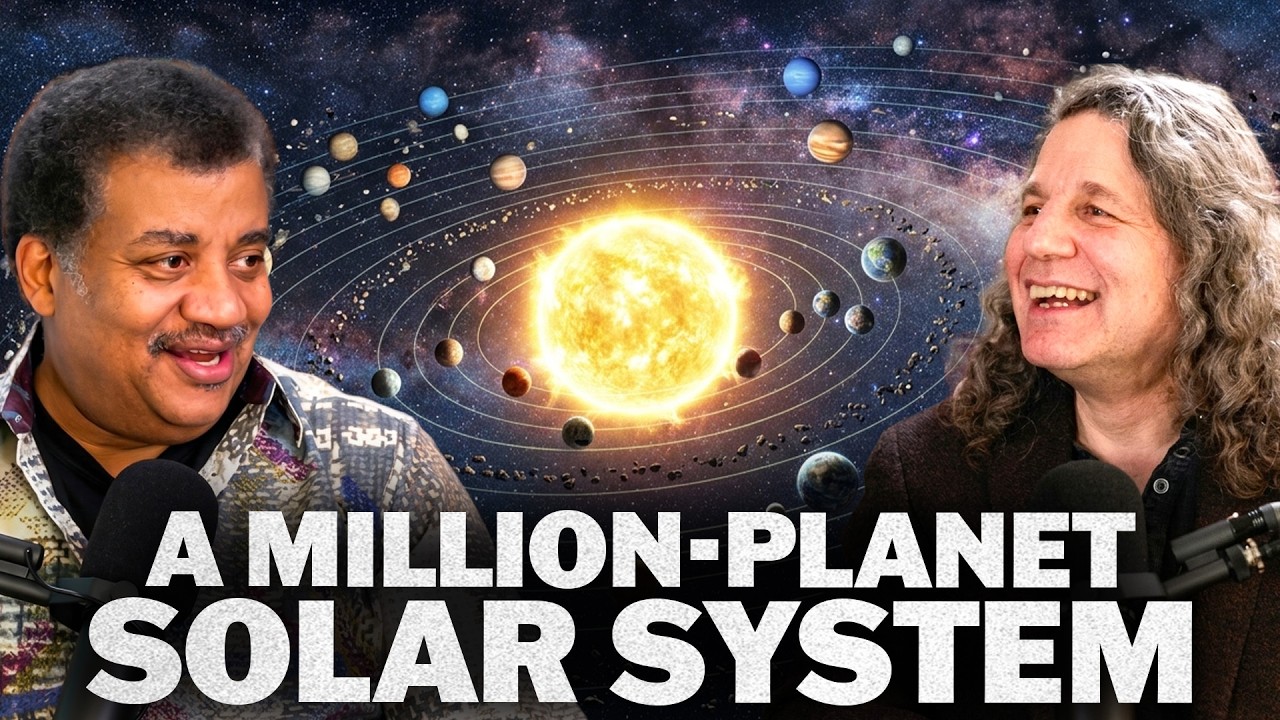
"If you're in a disc around a super massive black hole, a 100 million times as massive as the sun, there's an awful lot of dust in that disc and it's awful large. And you don't form three planets or eight planets, you form a million planets."
About this episode
Neil deGrasse Tyson hosts astrophysicist Mordecai-Mark Mac Low and comedian Negin Farsad for a Cosmic Queries episode examining planet and galaxy formation. Mac Low, the founding hire of the American Museum of Natural History's astrophysics department and a 37-year colleague of Tyson's, specializes in computer simulations that model cosmic processes impossible to calculate by hand. The conversation reveals several striking findings: every galaxy in the universe formed through violent collisions with other galaxies, with disturbed-looking 'peculiar galaxies' simply caught mid-crash before blenderizing into smooth elliptical forms. Mac Low discloses recently accepted research showing supermassive black holes can spawn million-planet systems containing Jupiter-mass rocky worlds, though the extreme radiation environment would be hostile to life. He reveals evidence that the Milky Way's central black hole had a major outburst just 5 million years ago, detected via shock waves spreading through the galaxy. The discussion covers how black holes become the brightest objects in the universe by heating infalling gas to billions of degrees, why magnetic fields and turbulence both promote and inhibit star formation, and how computer simulations must constantly be validated against observations to avoid being mere sandbox play. Mac Low explains that despite the universe's apparent chaos involving collisions, explosions, and turbulence, it remains comprehensible through just a few fundamental laws of physics, keeping astrophysicists employed rather than retired to the Bahamas.
Key takeaways
- Mordecai-Mark Mac Low reveals the Milky Way's supermassive black hole experienced a major outburst 5 million years ago detected via gamma-ray satellite shock wave observations.
- Newly accepted research demonstrates supermassive black holes can form million-planet systems with Jupiter-mass rocky worlds in hostile radiation environments.
- Computer simulations have definitively shown every galaxy in the universe formed through violent collisions, with peculiar galaxies being galaxies caught mid-crash.
- Black holes become the universe's brightest objects by heating infalling gas to billions of degrees through extreme gravitational compression before material crosses the event horizon.
- The Milky Way's supermassive black hole contains only one million solar masses compared to the largest quasars at one billion solar masses.
- Planet formation around normal stars now appears to occur much faster than previously thought, potentially during the main stellar accretion phase rather than millions of years later.
- All computer simulations of cosmic phenomena must be constantly validated against real observations to avoid being untethered theoretical exercises divorced from physical reality.