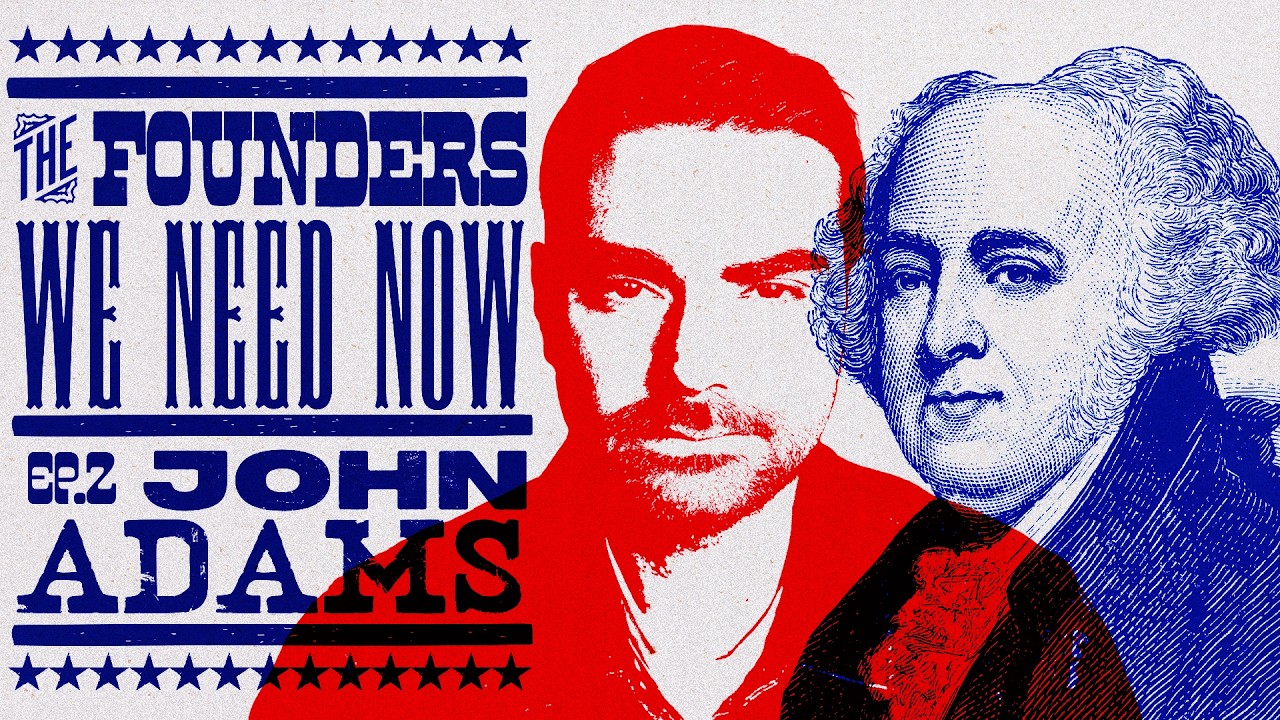
John Adams Warned Constitution Inadequate Without Moral and Religious People
"We have no government armed with power capable of contending with human passions unbridled by morality and religion. Avarice, ambition, revenge, or gallantry would break the strongest cords of our Constitution as a whale goes through a net. Our Constitution was made only for a moral and religious people. It is wholly inadequate to the government of any other."
About this episode
Host Ben Shapiro presents the second installment of his series on founding fathers most relevant to modern America, arguing that John Adams, the pessimist among America's architects, best diagnosed the nation's current dysfunction. Shapiro contends that Adams uniquely understood virtue as the keystone of the American experiment, believing that constitutional structures alone cannot preserve liberty without a morally grounded citizenry. The episode traces Adams's life from his defense of British soldiers after the Boston Massacre to his presidency, emphasizing his conviction that great civilizations die by suicide through character decay rather than external conquest. Shapiro highlights Adams's famous warning that the Constitution was made only for a moral and religious people and is wholly inadequate for governing any other. Drawing on Adams's extensive correspondence with wife Abigail and his personal diaries, Shapiro portrays virtue not as innate but as cultivated through families, churches, and civic institutions that government cannot replace. The episode presents data showing dramatic declines in American religious affiliation and church membership, framing this as evidence of the cultural erosion Adams feared. Shapiro argues that modern America has confused virtue with politeness or performative morality while abandoning the ancient understanding of virtue as self-governance, honesty, duty, and delayed gratification. He concludes that Adams would be horrified by contemporary America's collapse of trust, institutional failure, family strain, fiscal irresponsibility, and cultural obsession with rights over responsibility, challenging listeners to cultivate the personal virtue Adams believed essential to preserving freedom.
Key takeaways
- John Adams believed the Constitution alone cannot preserve liberty without a virtuous, morally grounded citizenry capable of self-governance.
- Adams defended British soldiers after the Boston Massacre despite revolutionary sympathies, insisting that facts and justice must supersede public emotion and mob demands.
- The Bible was the most cited source in founding-era political literature, with Deuteronomy cited nearly twice as often as John Locke.
- Religious identification among Christians dropped from 95 percent in the mid-20th century to 62 percent today, with church membership falling below 50 percent.
- Adams feared democracy degenerating into mob rule as much as monarchy degenerating into tyranny, recognizing human nature as the common corruptor of all government forms.
- Virtue in Adams's view comprised honesty, self-command, duty, courage, and delayed gratification, cultivated primarily through families, churches, and communities rather than government.
- Adams's partnership with wife Abigail demonstrated how civic virtue was sustained through institutions like marriage and family rather than political structures alone.