AI Solves IMO Geometry in 19 Seconds Using Brute Force Method
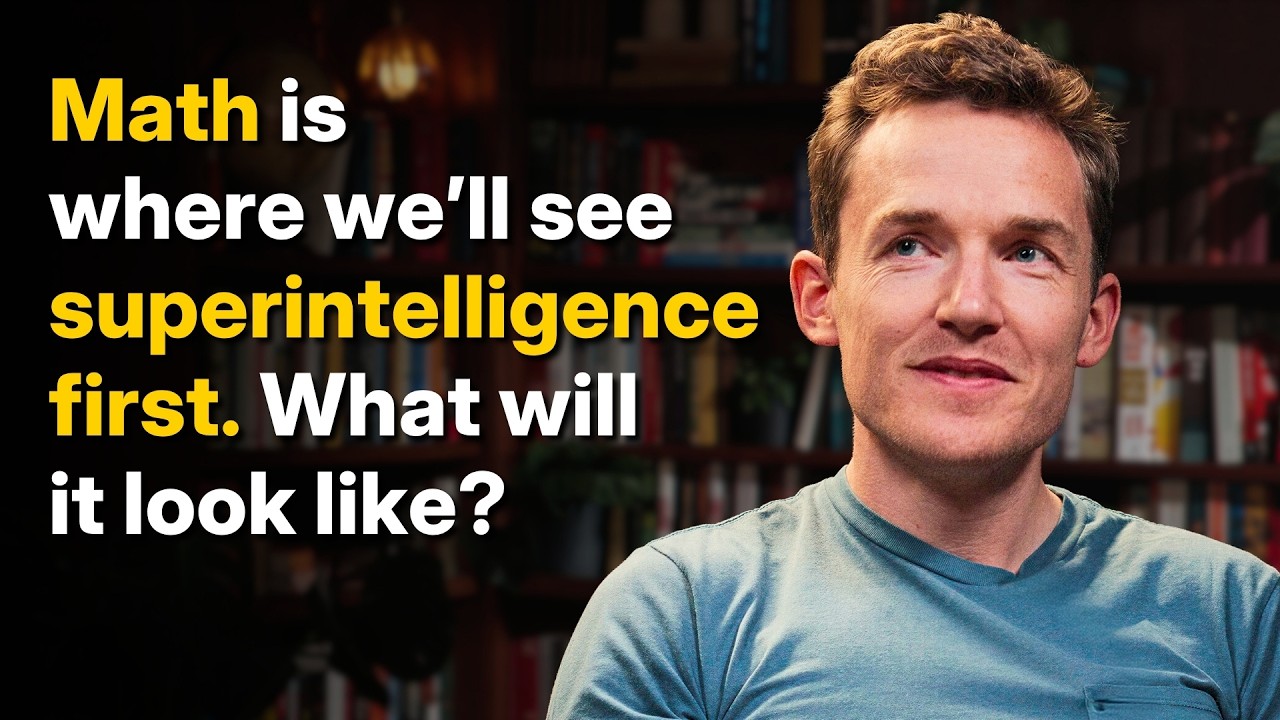
"Geometry, just solves in like 19 seconds in 2024, 'cause it's kind of a brute force solver. And the dirty secret is for students, there's also sort of a brute force way that you kind of can go at it."
About this episode
In this episode, host Dwarkesh Patel interviews Grant Sanderson, creator of 3Blue1Brown, about AI's rapid progress in mathematics and what it reveals about the future of artificial intelligence. Sanderson, who is documenting AI's mathematical achievements in a forthcoming series, explains why AI reaching gold-medal performance at the International Math Olympiad did not mark an AGI moment as many predicted, contrary to expectations Patel voiced three years earlier. The conversation reveals that AI systems like those from DeepMind solved IMO geometry problems in 19 seconds through brute force rather than creativity, yet still struggled with combinatorics problems requiring novel insights. A central theme emerges around the challenge of training AI to generate genuinely novel mathematical concepts rather than just proving theorems. Sanderson traces this through the historical example of Galois and group theory, whose revolutionary insights took nearly 100 years to be recognized as valuable because the verification loop for breakthrough mathematics can span generations. Patel argues that AI's mathematical progress stems not just from verifiable outcomes but from the ability to parallelize unlimited attempts in containerized environments, a property unique to math and coding. The pair discuss whether AI will eventually make connections between disparate mathematical fields, citing the famous Montgomery-Dyson conversation that linked number theory to quantum physics. Looking forward, Sanderson predicts human mathematicians will transition from theorem-proving to curation roles, helping society navigate vast landscapes of AI-generated mathematics. They explore why current AI systems remain surprisingly weak at theory of mind, writing quality prose, and escaping their training context, while excelling at technical explanations and cross-field connections. The conversation concludes with practical advice for students considering mathematics careers in an AI-dominated future, emphasizing the enduring value of teaching, curation, and understanding where mathematical work creates genuine economic or social value.
Key takeaways
- AI solved IMO geometry problems in 19 seconds via brute force and would have won gold in 2024 with more geometry questions instead of combinatorics.
- Galois's group theory insights took nearly 100 years to be recognized as valuable, creating fundamental challenges for training AI to discover breakthrough mathematics.
- AI math progress stems from grindability not just verifiability, as unlimited parallel attempts in containerized environments enable breakthrough performance impossible in real-world domains.
- The Montgomery-Dyson conversation linking Riemann zeta zeros to random matrix theory exemplifies how AI with superhuman breadth could solve major problems through unexpected cross-field connections.
- Sanderson predicts human mathematicians will transition to museum curator roles, helping society navigate the infinite space of AI-generated mathematical insights.
- AI systems remain surprisingly weak at theory of mind and escaping training context despite superhuman knowledge breadth, limiting their ability to generate truly novel conceptualizations.
- Students pursuing mathematics should focus on understanding where money flows from and what value they add, particularly in teaching roles that remain stable post-AGI due to their relational nature.