Steve Keen says 2014 Bank of England paper challenged textbook banking model
"“Banks are not intermediaries. Banks create money by creating debt. And that argument has only been made by critics of the economics for Decades, but in 2014, the Bank of England actually came out and said that critics like me are right and the textbooks are wrong.”"
About this episode
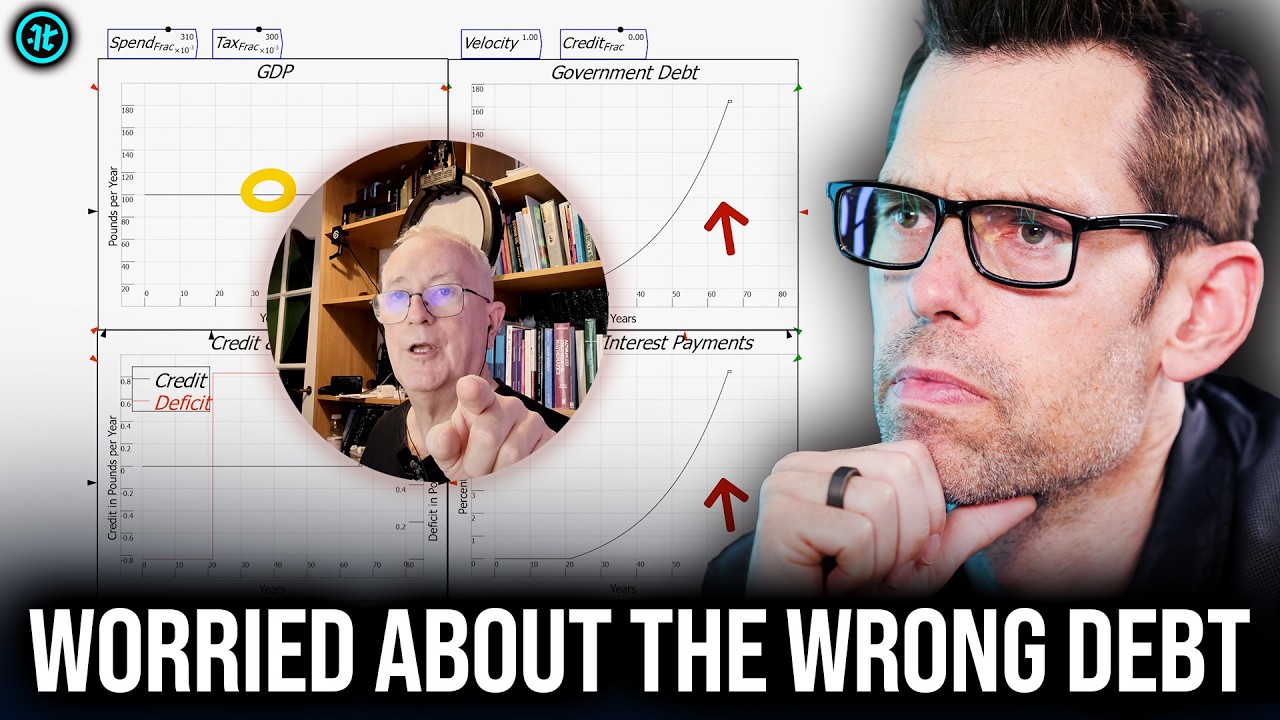
Tom Bilyeu reviews and comments on a Steve Keen segment arguing that widely circulated warnings about an impending government-debt crisis misunderstand how money is created. Keen disputes projections cited by the US Government Accountability Office and similar institutions internationally, contending that mainstream models focus on public debt while overlooking the macroeconomic role of private credit. A central plank of Keen’s argument is that banks are not mere intermediaries lending out deposits; he cites a 2014 Bank of England paper which he says explicitly rejects the “loanable funds” framing and the “money multiplier” model. Bilyeu expands on the double-entry bookkeeping claim that bank lending creates deposits and that debt repayment can extinguish money, linking changes in private credit to swings in GDP and employment. He also voices reservations about simplifications around interest rates and borrower psychology, pointing to Japan as an example where low rates may not revive borrowing. Later, Bilyeu offers his own interpretation of post-2008 and pandemic-era policy: he says 2008-era interventions did not trigger major inflation, but that Covid stimulus collided with supply disruptions, producing what he calls a roughly 30% jump in prices and a continuing fall in real purchasing power since 2019. The episode closes with Bilyeu saying Keen’s framework will shape his own economic worldview, while noting potential moral hazard in proposals such as recurring debt jubilees.
Key takeaways
- Steve Keen argues that “government debt crisis” warnings rest on a mistaken model of money and banking.
- Keen cites a 2014 Bank of England publication as rejecting “loanable funds” and “money multiplier” textbook models.
- Bilyeu emphasises the claim that bank lending creates deposits, and that repayment can destroy money rather than merely transfer it.
- Keen links private credit creation to GDP movements and to employment/unemployment patterns, criticising mainstream economists for ignoring private debt.
- Bilyeu says interest rates and borrower psychology can constrain lending even if banks can create money.
- Bilyeu claims Covid-era stimulus, combined with supply disruption, drove a roughly 30% price-level increase and reduced real living standards versus 2019.