Megyn Kelly Show
Episode overview

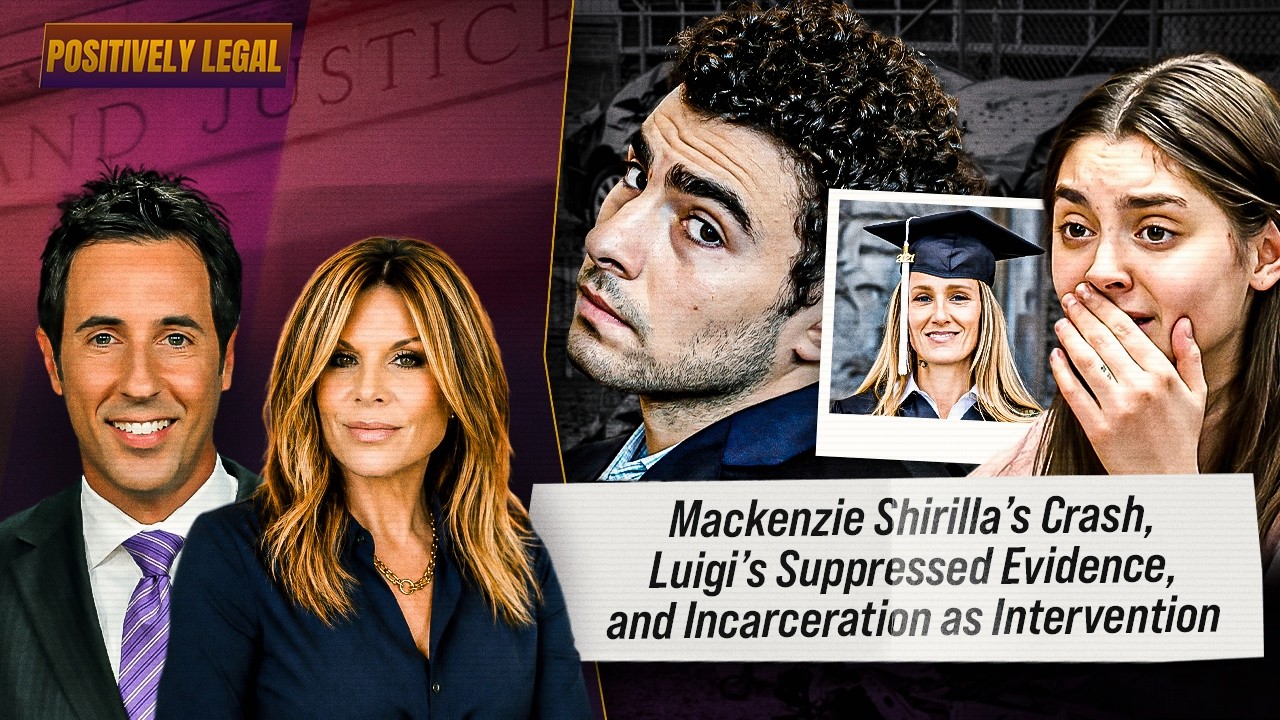
Luigi Mangione's Suppressed Evidence, Mackenzie Shirilla’s "Crash" Doc - "Positively Legal" with Mark Eiglarsh and Jonna Spilbor

Megyn Kelly Show · 20 May 2026 · 5 Egleze moments
Luigi Mangione's Suppressed Evidence, Mackenzie Shirilla’s "Crash" Doc - "Positively Legal" with Mark Eiglarsh and Jonna Spilbor ▶

What happened in this episode?

Hosts Jonna Spilbor and Marc Eiglarsh present this episode of Positively Legal, part of Megyn Kelly's MK True Crime franchise, covering major criminal justice developments and featuring an extraordinary rehabilitation success story. The episode opens with legal updates on Luigi Mangione's murder case, where a judge suppressed evidence from an improper search at McDonald's while allowing his gun and manifesto to remain admissible for his trial in the killing of UnitedHealth CEO Brian Thompson. The hosts express disgust at Mangione's fan club, who celebrated the murder outside court. They then analyze the Netflix documentary The Crash, examining whether 17-year-old Mackenzie Sherilla deserved her murder conviction for deliberately driving 100 mph into a building, killing her boyfriend and friend. The centerpiece of the episode is an in-depth interview with Ginny Burton, a systems change agent who overcame 40 years of addiction and three prison sentences to develop the OUT program (Overhaul Unrelenting Transfiguration). Burton reveals she was introduced to drugs at age seven by her addicted mother and cycled through the criminal justice system until age 40. She now teaches her abstinence-based Gabriel Plan inside Tennessee prisons, reporting only one recidivism case among 51 released inmates. Burton delivers controversial claims that the addiction treatment industry deliberately keeps patients sick for profit, arguing that pharmaceutical companies and rehab facilities benefit from return customers. She criticizes the 2013-2015 shift that rebranded addiction as substance use disorder, making everything Medicaid reimbursable and pushing medication-assisted treatment. Burton argues that immediately medicating inmates and patients prevents the mental clarity necessary for genuine transformation. The episode concludes with off-the-record segments including a My Cousin Vinny courtroom scene analysis and a rant about lenient sentencing for a South Carolina clerk who tampered with Alex Murdaugh's jury.

What are the key points?

Which topics are covered?

How is this page sourced?

Programme
Megyn Kelly Show
Published
20 May 2026
Original episode
Open the original source ↗

Egleze verifies the speaker, source and timestamp for each linked moment. Unless a moment is explicitly marked independently verified, statements remain attributed claims by the named speaker rather than established facts.

Watch original episode More from Megyn Kelly Show

5 moments from this episode

Source-linked · editorially selected
01
Crime & Justice

Judge Blocks Key Evidence in Luigi Mangione State Murder Trial

at 11:39 · Attributed speaker claim
I find that the search of the backpack at the McDonald's was improper warrantless search, that the backpack was not within the immediate control or grabbable area of the defendant, and further, the people failed to demonstrate exigent circumstances. Therefore, those items found in the backpack during the search at the McDonald's will be suppressed.

A New York judge ruled that evidence seized from Luigi Mangione's backpack at a McDonald's must be suppressed due to an improper warrantless search. However, items recovered during a subsequent inventory search at the police station remain admissible, along with the gun and Mangione's manifesto. Mangione faces both state and federal charges for the caught-on-camera killing of UnitedHealth CEO Brian Thompson on a Manhattan street.

02
Crime & Justice

System Change Agent Reveals She Was Given Drugs at Age Seven by Mother

at 29:32 · Attributed speaker claim
My mom did. She introduced drugs to me. I was 7 years old. I think it made it easier for her to participate in some of the things that she was. And in order for her kids not to say anything, she introduced them to us.

Ginny Burton disclosed that her mother, a drug addict, intentionally introduced her to narcotics at age seven to silence her about household activities. Burton's father was imprisoned when she was four after their house was raided. Despite this traumatic childhood, Burton now works as a systems change agent and has developed the Gabriel Plan rehabilitation program showing extraordinary success rates in prisons.

03
Crime & Justice

Rehabilitation Expert Says Inmates Immediately Put on Drugs Preventing Real Recovery

at 36:42 · Attributed speaker claim
I'm going to tell you that today, when a person is separated, they're immediately put on drugs, whether it's through detox, whether it's a treatment program, whether it's prison, they are immediately put on drugs. And when you cannot access the deepest recesses of yourself, because you are continued to participate in chemical escape, what happens is people don't ever find that place of clarity.

Ginny Burton revealed that modern correctional and treatment facilities immediately medicate inmates and patients, preventing them from achieving the mental clarity necessary for genuine transformation. She contrasted this with earlier practices that allowed separation from destructive patterns without pharmaceutical intervention. Burton credits her own recovery at age 40 to achieving drug-free clarity while incarcerated.

04
Health, Longevity & Biohacking

Former Addict Claims Rehab Industry Keeps Patients Sick for Profit

at 37:29 · Attributed speaker claim
When we have blamed the pharmaceutical companies for the problem of opiate addiction, are we all really so dim that we think that the pharmaceutical companies are actually the answer to the very problem we're suggesting that they created? Isn't their business model exactly the same? How does any drug dealer make money? Return customers.

Ginny Burton, who overcame 40 years of addiction and three prison sentences, accused the addiction treatment industry of deliberately maintaining patient dependency for financial gain. She claims the shift between 2013-2015 to rebrand addiction as substance use disorder made everything Medicaid reimbursable and pushed medication-assisted treatment with pharmaceutical companies at the helm. Burton argues abstinence-based approaches are suppressed because they don't generate recurring revenue.

05
Crime & Justice

Ex-Addict Reveals Only One Out of 51 Prison Inmates Reoffended After Her Program

at 44:24 · Attributed speaker claim
Out of 51 people that have been released, only one has recidivated. Out of that one that's recidivated, he has made his way back to the program because though we participate in familiarity in behaviors that have helped us to escape challenge in the past, what we really want is we really want to be good people.

Ginny Burton, founder of the OUT program teaching inside prisons, reported extraordinary success rates with only one recidivism case among 51 released inmates. Her abstinence-based approach focuses on personal accountability and addresses life deficits rather than medication-assisted treatment. Burton argues the current system prioritizes long-term management over actual recovery because agencies profit from keeping people sick.