Huberman Lab
Episode overview

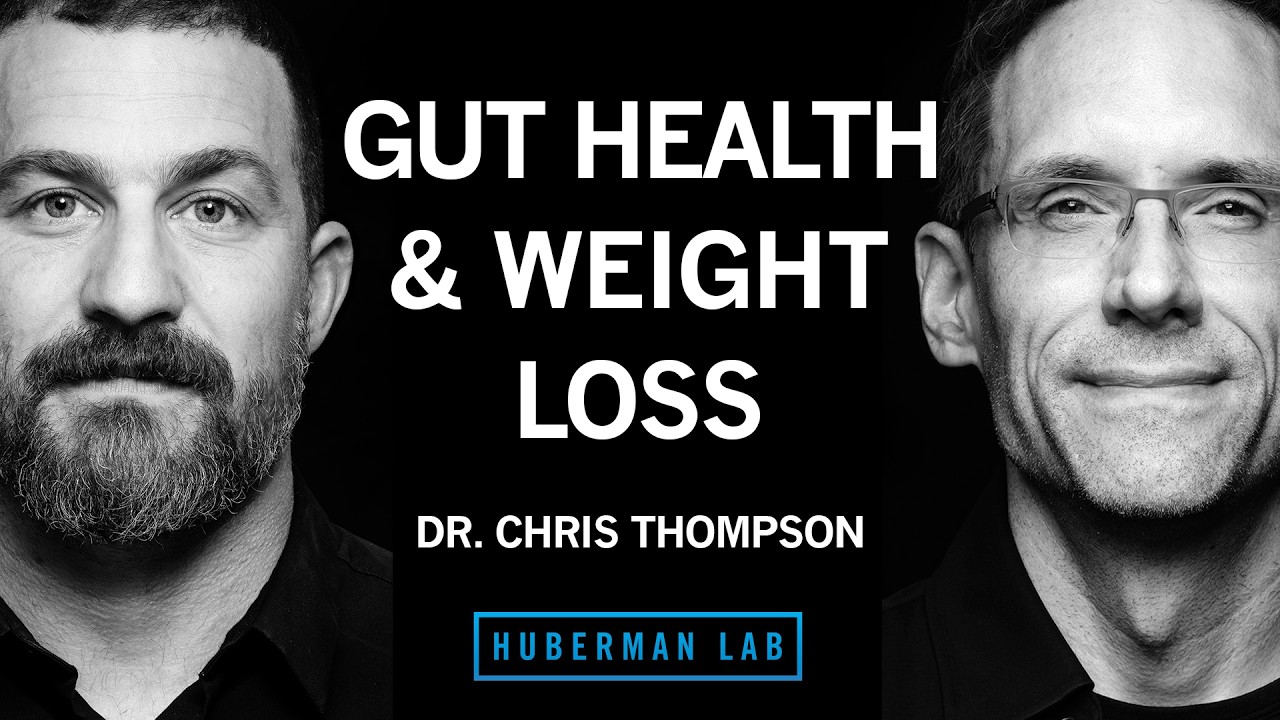
Best Tools for Gut Health & Weight Loss | Dr. Chris Thompson

Huberman Lab · 21 September 2026 · 2h 27m · 7 Egleze moments
Best Tools for Gut Health & Weight Loss | Dr. Chris Thompson ▶

What happened in this episode?

Andrew Huberman interviews Dr Chris Thompson, a Harvard Medical School professor and chief of interventional gastroenterology at Massachusetts General Hospital, on gut physiology, obesity and emerging metabolic treatments. Thompson outlines how the oesophagus, stomach, small bowel and colon contribute not only to digestion but to hormone signalling, including ghrelin, CCK, GIP, GLP-1 and peptide YY. He argues that fibre and fermented foods support the microbiome’s production of short-chain fatty acids such as butyrate, which he links to gut barrier function and satiety pathways.

The conversation turns to obesity medicines, with Thompson discussing GLP-1 drugs’ benefits and limitations, including nausea, muscle loss and what he describes as high discontinuation rates. He describes an off-label patient practice of “micro dosing” by decanting pen injectors into sterile vials, and warns that cycling on and off GLP-1s could worsen body composition if lean mass is not preserved.

Thompson also advocates earlier metabolic risk detection—citing fasting insulin as an early warning signal and noting tools such as CGMs, DEXA and measures of visceral and ectopic fat. He describes procedural innovations, from endoscopic suturing approaches informed by gastric bypass physiology to duodenal ablation intended to ‘reset’ diseased tissue and improve HbA1c. Looking ahead, he highlights AI-assisted endoscopy, robotics, and a pancreas-targeted GLP-1 gene therapy programme he says has entered clinical trials in the Netherlands.

What are the key points?

Who is speaking?

Named speakers identified in Egleze's source-linked moments from this episode.

Which topics are covered?

How is this page sourced?

Programme
Huberman Lab
Published
21 September 2026
Duration
2h 27m
Original episode
Open the original source ↗

Egleze verifies the speaker, source and timestamp for each linked moment. Unless a moment is explicitly marked independently verified, statements remain attributed claims by the named speaker rather than established facts.

Watch original episode More from Huberman Lab

7 moments from this episode

Source-linked · editorially selected
01
Health, Longevity & Biohacking

Dr Chris Thompson says many patients discontinue GLP-1 drugs within a year

Dr. Chris Thompson · at 31:22 · Attributed speaker claim
"About 30% come off GLP-1s in the first month and then 50% or so by by the end of the year, right?"

Dr Chris Thompson, a Harvard Medical School professor and interventional gastroenterologist, says adherence to GLP-1 medicines is a challenge and claims around 30% of users stop within the first month and roughly half stop by the end of the first year. He says the pattern resembles drop-off seen with other long-term medicines and discusses potential drivers including nausea during dose escalation, injection “needle fatigue” and uncertainty about long-term effects.

02
Health, Longevity & Biohacking

Dr Chris Thompson describes patients ‘micro-dosing’ GLP-1s by decanting pen doses into vials

Dr. Chris Thompson · at 34:44 · Attributed speaker claim
"He said, you know, I it's a it's too expensive, you know, b I don't feel great on it and c I'm doing this thing where I take the pen and I inject it into a sterile vial and they use a an insulin syringe and I'll take a small amount out and I'll give it to myself."

Dr Chris Thompson says he first heard of GLP-1 “micro-dosing” from a patient who was also a physician and who described injecting the contents of a pen into a sterile vial, then drawing smaller amounts with an insulin syringe. Thompson says many of his patients now do something similar, often as a maintenance approach, and links the practice to cost and side-effect tolerability, while describing it as outside standard, approved dosing.

03
Health, Longevity & Biohacking

Dr Chris Thompson says Whitehall II links fasting insulin to earlier diabetes risk

Dr. Chris Thompson · at 1:08:48 · Attributed speaker claim
"They saw that if someone had high fasting insulin, they're more likely to get diabetes long term. So, so and it was a long period of time. It was like a 10 15 year time. They could detect this thing 15 years earlier."

Dr Chris Thompson cites the Whitehall II study and says higher fasting insulin was linked to later diabetes, detectable 10–15 years in advance. He argues routine care often overlooks fasting insulin and recommends earlier metabolic-risk checks, including limited use of continuous glucose monitors.

04
AI & Tech

Dr Chris Thompson says AI can coach endoscopic stitching in research centres

Dr. Chris Thompson · at 1:26:54 · Attributed speaker claim
"It can actually point to something where you want to put your stitch, right? And it can count the stitches as you're placing them and tell you if they're close enough together."

Dr Chris Thompson says emerging AI systems can provide real-time, heads-up guidance during endoscopic procedures, including highlighting structures and suggesting stitch placement and spacing. He says these tools are not yet widely available and are mainly seen in research settings, but he expects wider impact alongside robotics.

05
Health, Longevity & Biohacking

Dr Chris Thompson recalls fistula closure after bypass linked to diabetes improvement

Dr. Chris Thompson · at 1:43:45 · Attributed speaker claim
"The reflux stopped, but the person started losing weight and their diabetes went away almost immediately again."

Dr Chris Thompson recalls treating a gastric bypass patient with reflux, weight regain and returning diabetes by endoscopically suturing a small fistula between the pouch and remnant stomach. He says the reflux resolved and that the patient then lost weight again and saw diabetes improve, which led him to study gut-hormone and foregut-exclusion mechanisms.

06
Health, Longevity & Biohacking

Dr Chris Thompson claims duodenal ablation can cut HbA1c by over a point

Dr. Chris Thompson · at 1:50:21 · Attributed speaker claim
"Now you don't have a sleeve in place. You don't reroute any bowel. You just ablate the douadinum. Okay. And what happens is your A1C drops by over a point."

Dr Chris Thompson says an endoscopic duodenal ablation procedure can lower HbA1c by more than one percentage point, even without major weight loss. He also says unpublished studies suggest it may reduce weight regain after stopping GLP-1 medicines.

07
Health, Longevity & Biohacking

Dr Chris Thompson describes pancreas-targeted GLP-1 gene-therapy concept using an insulin-promoter viral vector

Dr. Chris Thompson · at 2:17:23 · Attributed speaker claim
"They've developed a a viral vector, right, that has the gene for GLP1 in it and they're using the promoter for uh the beta cell insulin gene, right?"

Dr Chris Thompson says a company is pursuing a gene-therapy approach intended to make GLP-1 production more nutrient-responsive by placing a GLP-1 gene under control of a beta-cell insulin-gene promoter. He says the delivery method he describes involves endoscopic ultrasound-guided injection into the tail of the pancreas and that preclinical work has aimed to keep expression localised rather than systemic.