
Theories of Everything
Episode overview

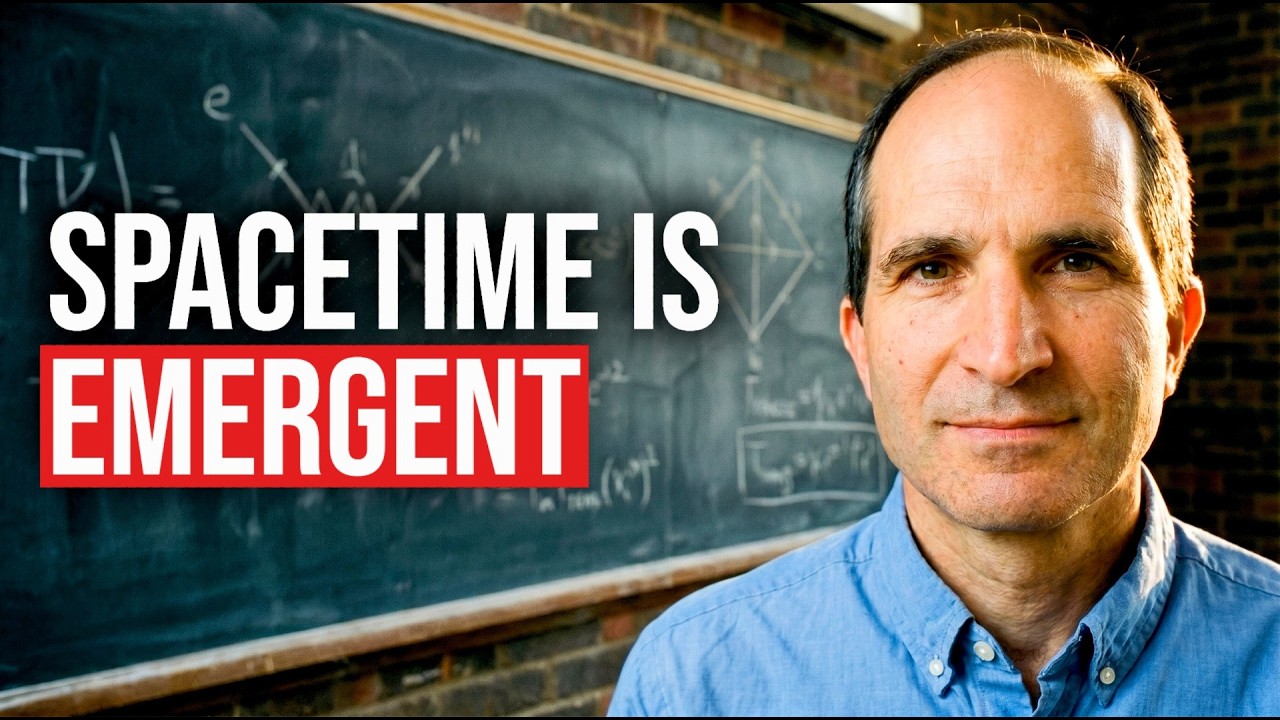
Juan Maldacena: Geometry as Entanglement, and the Emergence of Spacetime

Theories of Everything · 4 Egleze moments
Juan Maldacena: Geometry as Entanglement, and the Emergence of Spacetime
Episode summary

In this episode of Theories of Everything, host Curt Jaimungal interviews Juan Maldacena, the theoretical physicist behind the most-cited paper in the field and architect of the AdS/CFT correspondence. Maldacena explains that spacetime in general relativity is not made of anything more fundamental, but quantum considerations suggest it may emerge from quantum degrees of freedom living on the boundary of spacetime. The conversation explores black hole interiors, where singularities represent places physics currently cannot describe, and the recent island formula breakthroughs by Pennington and Witten that resolve how black holes preserve quantum information. Maldacena reveals he is actively working to resolve fundamental incompatibilities surrounding wormholes in quantum gravity, describing them as 'leaky pipes' where different theoretical frameworks do not fit together. He argues that quantum gravity requires observers to be included in the system, stating there is no 'view from nowhere' and that measurements are fundamentally embedded in spacetime structure. On cosmology, Maldacena expressed skepticism about DESI results suggesting dark energy's equation of state might be below -1, calling such a finding potentially the biggest news in 100 years but predicting it will not survive scrutiny. The episode closes with Maldacena sharing that as a graduate student he struggled with feelings of inadequacy, advising students to persist, question lore in their fields, and understand concepts deeply rather than repeating what everyone says.

Key points
Watch original episode More from Theories of Everything

4 moments from this episode

Source-linked · editorially selected
01
Science

Leading Physicist Admits He Once Told Students Their Great Ideas Were Wrong

Juan Maldacena revealed that one of his PhD students proposed a major generalization of the Ryu-Takayanagi formula for black hole entropy, which Maldacena initially rejected as incorrect. The idea turned out to be valid but the student never published, and others later claimed credit. Maldacena described this as one of his failures as an advisor, offering a rare glimpse into how breakthrough physics can be dismissed even by top experts.

Read this moment →
02
Science

Maldacena Claims Observers Are Required in Quantum Gravity Theory

Juan Maldacena, author of the most-cited paper in theoretical physics, argues that quantum gravity cannot be formulated from a perspective outside the system. In perturbative quantum gravity calculations for de Sitter space, certain entropy quantities yield imaginary or negative values unless a physical observer is included in the equations. This suggests that measurement and observation are fundamentally embedded in the structure of spacetime at the quantum level, not external to it.

Read this moment →
03
Science

Maldacena Questions Whether Dark Energy Below Negative One Would Survive Scrutiny

Maldacena expressed skepticism about recent DESI cosmology results suggesting the dark energy equation of state parameter w might be less than -1. Such a finding would violate fundamental principles of causality and energy conditions that Maldacena considers sacred. He predicted the result will not hold up under further analysis, but acknowledged that if confirmed, it would represent the biggest physics discovery in a century.

Read this moment →
04
Science

Maldacena Reveals Conceptual Crisis Around Wormholes in String Theory

Maldacena disclosed he is actively working to resolve fundamental incompatibilities in how wormholes are treated across different theoretical frameworks. Wormholes are essential for deriving the island formula and black hole entropy calculations, yet they also suggest constants of nature should be averaged over, conflicting with string theory models where constants are fixed. This represents one of the hottest unsolved problems in quantum gravity.

Read this moment →