Modern Wisdom
Episode overview

Harvard Professor: Why Nothing Feels Real Anymore - Arthur Brooks - #1109

Modern Wisdom · 5 Egleze moments
Harvard Professor: Why Nothing Feels Real Anymore - Arthur Brooks - #1109
Episode summary

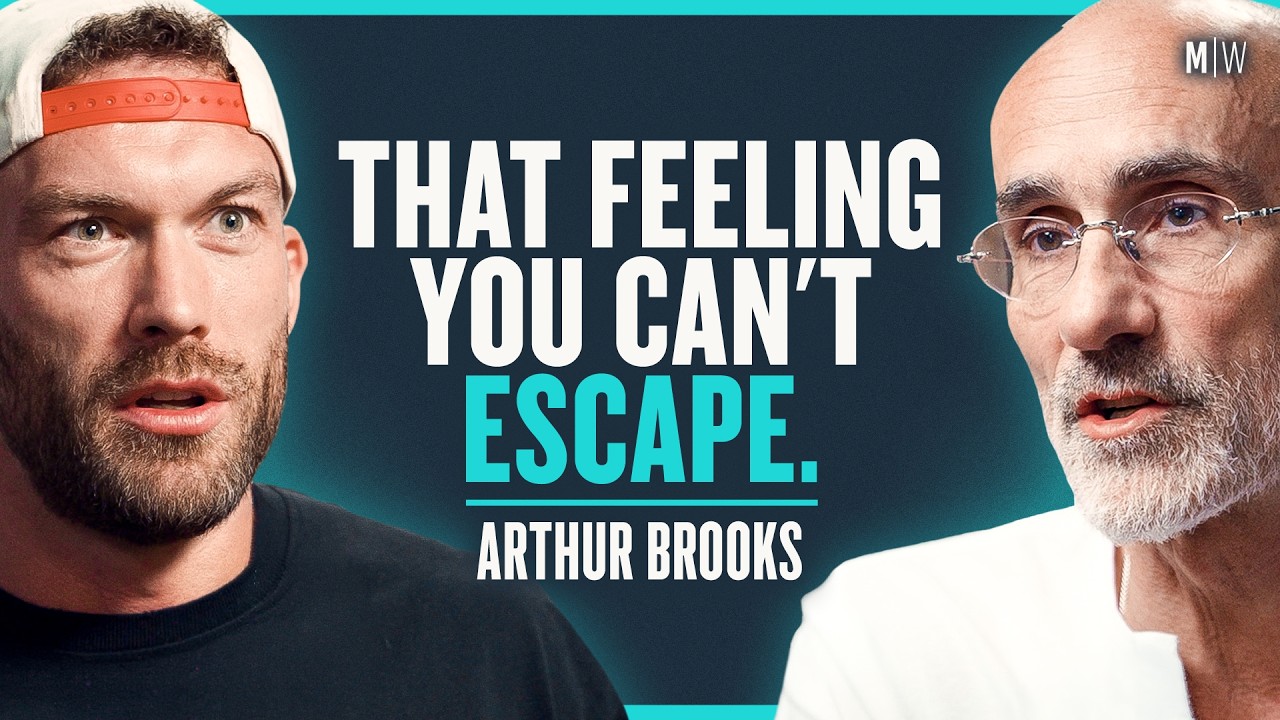
Harvard professor Arthur Brooks joined Chris Williamson for a sprawling conversation diagnosing the modern meaning crisis and its neurological roots. Brooks argued that contemporary society functions as an actual Matrix controlled by algorithms rather than AI, creating left-brain simulations of right-brain needs like love and meaning while feeding on human attention and energy. He presented clinical data showing depression has tripled and anxiety doubled since 2008, attributing this not to economic factors but to the average American checking their phone 205 times daily, which forces people into the wrong brain hemisphere and blocks access to meaning—the biggest predictor of mental health. Brooks explained that modern technology culture represents the dominance of left-brain complicated problems over right-brain complex mysteries, leaving people unable to experience the unsolvable dimensions of life that create actual fulfillment. He revealed Universal Basic Income experiments failed because free money violated human evolutionary wiring for earned success, and shared the story of his former fitness-influencer physical therapist who showered in darkness for a year to break free from mirror addiction. The conversation covered the difference between specialness and happiness, why strivers chase achievement to earn love they were never freely given as children, and how romantic relationships and suffering are essential to meaning. Brooks offered practical protocols including phone-free times and zones, 96-hour annual technology fasts, and the importance of boredom, beauty, transcendence, and leaning into pain rather than avoiding it.

Key points
Watch original episode More from Modern Wisdom

5 moments from this episode

Source-linked · editorially selected
01
Society

Fitness Influencer Showered in Dark for Year to Escape Mirror Addiction

Brooks shared the account of his physical therapist who was formerly a fitness influencer. After a decade of misery focused on his appearance and social media validation, the man deleted all accounts, enrolled in acupuncture school, and removed every mirror from his home, showering in darkness for a full year to break his narcissistic fixation and regain happiness.

Read this moment →
02
Health, Longevity & Biohacking

Depression Tripled Since 2008 Due to Screen Time Not Economics

Brooks presented data showing clinical depression has tripled and anxiety doubled since 2008, arguing the cause is neurological rather than economic. He claims checking phones 205 times daily forces people into left-brain activity, blocking the right-hemisphere processes necessary for experiencing meaning, which is the biggest predictor of depression and anxiety.

Read this moment →
03
Relationships & Family

Wealthy Finance Icon Admits Riches Failed to Earn Wife's Love

Brooks recounted a conversation with a finance industry icon who knew at age 32 he would become wealthy. Decades later, the man confessed that despite massive success, his core motivation—earning his wife's genuine love through achievement—never materialized, illustrating Brooks' thesis that strivers select partners who make them earn love, perpetuating a cycle rooted in childhood conditioning.

Read this moment →
04
Society

Brooks Claims We Are Living in Literal Matrix Run by Algorithms

Harvard professor Arthur Brooks argues modern society functions as an actual simulation controlled by algorithms rather than artificial intelligence or human forces. He contends that dating apps, social media, and digital platforms create left-brain simulations of right-brain needs like love and meaning, keeping people placated while extracting value from their attention and energy.

Read this moment →
05
Society

UBI Experiments Failed Because People Lack Earned Success Mechanism

Brooks revealed that Universal Basic Income experiments failed not due to economic factors but because free money violated human evolutionary wiring. Recipients didn't invest in healthcare or education as predicted, and the lack of earned success removed the satisfaction mechanism central to human happiness, contradicting technocratic assumptions about solving poverty with money alone.

Read this moment →